







-
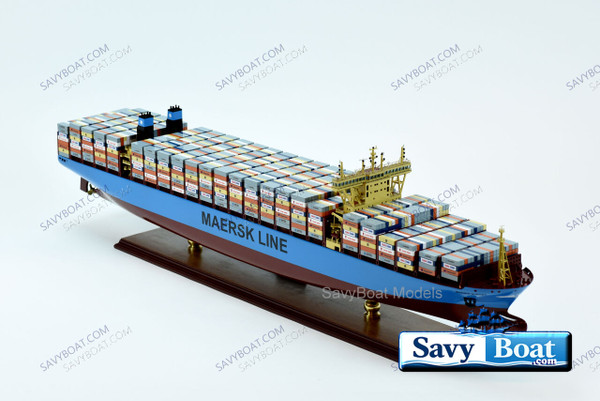

MAERSK MADRID CONTAINER SHIP
SAVY DIRECT PRICE $949.96MSRP: $999.99MAERSK MADRID CONTAINER SHIP FULLY BUILT AND READY TO DISPLAY MUSEUM QUALITY SHIP MODEL Dimension approx.: 39.3L x 6W x 9.8H(inch) The model is already built. THIS IS NOT A MODEL SHIP... -

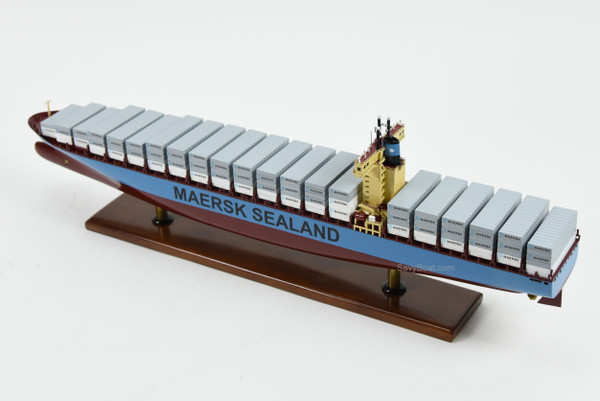
MAERSK SEALAND CONTAINER SHIP
SAVY DIRECT PRICE $949.96MSRP: $999.99MAERSK SEALAND CONTAINER SHIP FULLY BUILT AND READY TO DISPLAY, QUALITY SHIP MODEL Dimension approx.: 39.3L x 6W x 9.8H(inch) The model is already built. THIS IS NOT A MODEL SHIP... -
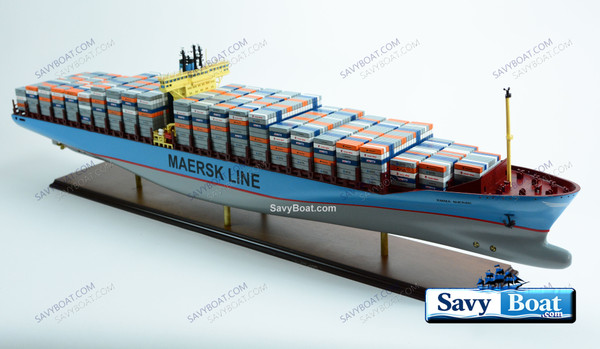
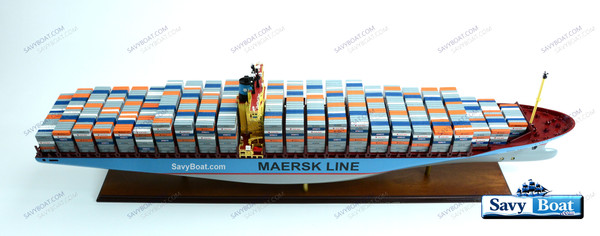
MAERSK EMMA CONTAINER 48” SHIP
SAVY DIRECT PRICE $1,099.96MSRP: $1,299.99Mærsk EMMA CONTAINER CARGO SHIP READY TO DISPLAY MUSEUM QUALITY SHIP MODEL Dimension Approx.: 48″L x 6.5"W x 13″H The model is already built, NOT a model ship kit
Description

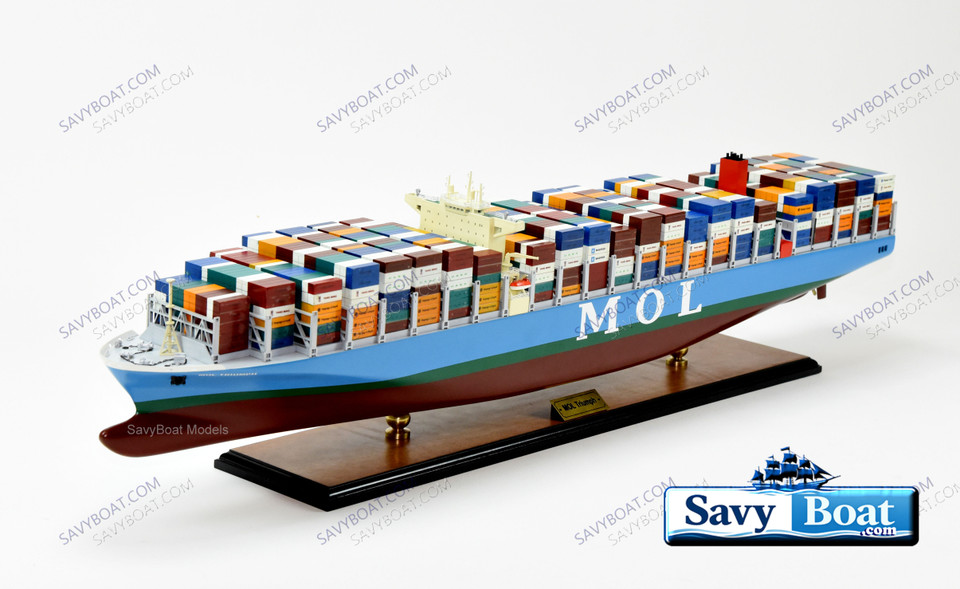
MAERSK MOL TRIUMPH CONTAINER SHIP
FULLY BUILT AND READY TO DISPLAY, QUALITY SHIP MODEL
- Dimension Approx.: 39.5″ L x 6″ W x 10″ H
- SCALE 1:400
- The model is already built, NOT a model ship kit
When the MOL Triumph slid down the ways at Samsung Heavy Industries in Geoje, South Korea, in March 2017, she represented a new summit in the race toward ever‑larger container ships. At 400 meters long and capable of carrying 20,170 TEU, she was, for a brief but brilliant moment, the largest container ship in the world — a steel giant built to serve the busiest trade routes on Earth.
Her christening on 15 March 2017 marked a milestone not only for Mitsui O.S.K. Lines (MOL), but for the entire maritime industry. She was the lead ship of a new class — the Triumph‑class, a family of five sister vessels (Trust, Tribute, Tradition, Truth, and Treasure) that embodied MOL’s push into the ultra‑large container segment. Her hull, stretching the length of four football fields, was engineered for both capacity and efficiency. Beneath her decks, a powerful MAN B&W G95ME diesel engine delivered more than 82,000 kW, pushing her across oceans at a service speed of 22 knots.
But raw power was only part of her story. The Triumph incorporated a suite of energy‑saving technologies: low‑friction hull coatings, a high‑efficiency rudder, and an optimized propeller — all designed to reduce resistance and cut fuel consumption. She was a vessel built for a world increasingly conscious of environmental impact, where efficiency was as important as size.
Her maiden voyage began in April 2017, departing Tianjin, China, and weaving through the great ports of East Asia — Dalian, Qingdao, Shanghai, Ningbo, Hong Kong, Yantian, and Singapore. From there she crossed the Indian Ocean, transited the Suez Canal, and entered the heart of Europe’s maritime network: Tangier, Southampton, Hamburg, Rotterdam, and Le Havre. It was a grand tour befitting a ship that symbolized MOL’s global ambitions.
For several years, the Triumph served as a flagship on the Asia–Europe FE2 service, carrying the goods that fuel global commerce — electronics, textiles, machinery, and countless other products that define modern life. Her immense capacity allowed MOL to consolidate cargo, reduce per‑container emissions, and compete in a market increasingly dominated by mega‑ships.
Then, in 2022, she entered dry dock for her first major inspection — and emerged transformed. MOL, NYK Line, and K‑Line had merged their container operations into Ocean Network Express (ONE), and the Triumph was reborn as ONE TRIUMPH, repainted in the company’s now‑iconic magenta livery. The rebranding marked her transition into a new corporate identity, but her role remained the same: a workhorse of the Asia–Europe corridor, a vessel built to move mountains of cargo with precision and reliability.
Today, the ONE Triumph continues to sail as one of the most recognizable ships in the ONE fleet. She is no longer the largest container ship afloat — the industry has already leapt beyond 24,000 TEU — but she remains a landmark in the evolution of ultra‑large container vessels. Her story is one of ambition, engineering, and adaptation, reflecting the rapid changes of global trade in the 21st century.