








-
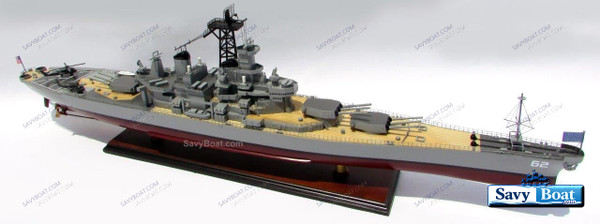

USS NEW JERSEY battleship 39" fully built wood model with stand
SAVY DIRECT PRICE $899.96MSRP: $949.99USS NEW JERSEY BATTLESHIP FULLY BUILT AND READY TO DISPLAY MUSEUM QUALITY SHIP MODEL Dimension approx.: 40″ L x 5″ W x 12″ H This beautiful model is already built, NOT a kit. USS New Jersey... -


RMS BERENGARIA STEAMSHIP 39" fully built wood model with stand
SAVY DIRECT PRICE $1,099.96MSRP: $1,199.99RMS BERENGARIA STEAMSHIP FULLY BUILT AND READY TO DISPLAY, QUALITY SHIP MODEL Dimension Approx.: 39″ (long) x 4.5″ (wide) x 13″ (high). The model is already built, NOT a model ship... -
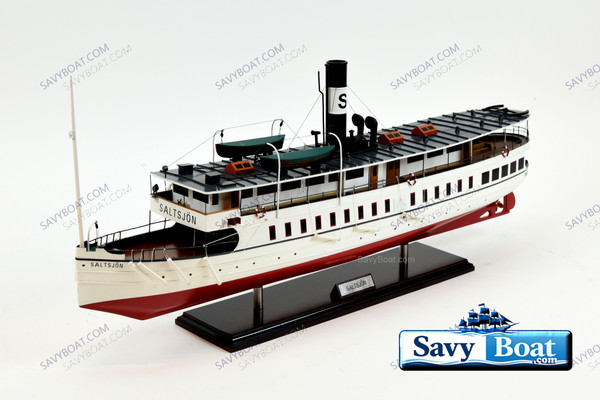
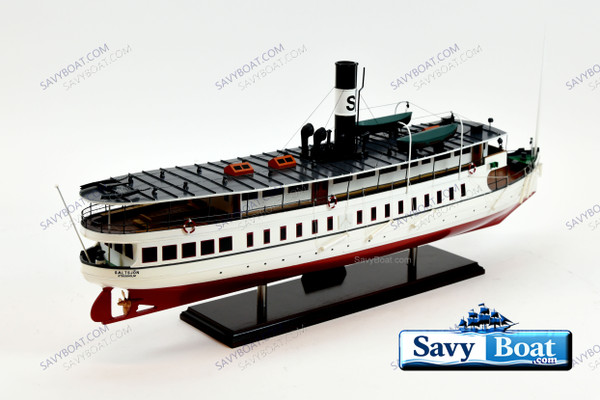
SALTJON ship 31" fully built wood model with stand
SAVY DIRECT PRICE $599.96MSRP: $649.99SALTSJÖN / BJÖRKFJÄRDEN MODEL STEAM SHIP FULLY BUILT AND READY TO DISPLAY, QUALITY SHIP MODEL Dimension approx.: 32″ L x 5.5″
Description

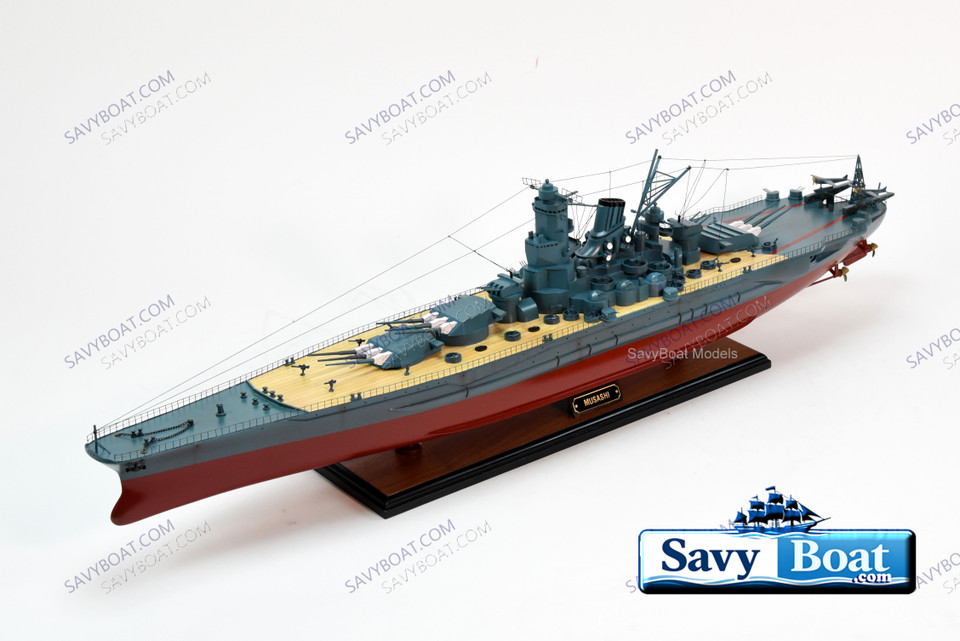
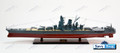
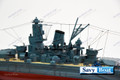
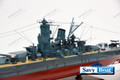
JAPENESE BATTLESHIP MUSASHI
FULLY BUILT AND READY TO DISPLAY MUSEUM QUALITY SHIP MODEL
- Dimension approx.: 39.5″ (long) x 6.5″ (wide) x 9.5″ (high).
- APPROX SCALE 1/350
- This beautiful model is already built, NOT a kit.
When the Imperial Japanese Navy laid down the keel of Battleship No. 2 at Mitsubishi’s Nagasaki shipyard in 1938, they were building not just a warship, but a statement. The vessel that would become Musashi was part of the Yamato‑class, the heaviest and most powerfully armed battleships ever constructed. Conceived in an era when Japan believed it could not match American shipbuilding capacity, the Yamato‑class embodied a different strategy: build ships so large and so heavily armed that each one could outfight any opponent.
Launched in 1940 under extraordinary secrecy — including a massive hemp curtain and a staged citywide air‑raid drill — Musashi displaced more than 71,000 tons fully loaded and carried nine 460 mm (18.1‑inch) guns, the largest naval artillery ever mounted on a warship. Her armor was immense, her machinery powerful, and her construction so vast that even her launch sent a 1.2‑meter wave sweeping through Nagasaki Harbor.
Commissioned in August 1942, Musashi was soon modified to serve as the flagship of the Combined Fleet, replacing her sister ship Yamato. She sailed to Truk Lagoon in early 1943, becoming the command ship of Admiral Isoroku Yamamoto. When Yamamoto was killed in April 1943, his ashes were returned to Truk aboard Musashi, a somber moment in the ship’s early career.
Throughout 1943 and early 1944, Musashi sortied repeatedly but saw little surface combat. She ferried troops and equipment across the Pacific, survived a torpedo hit from the submarine USS Tunny, and underwent major repairs in Japan — during which her anti‑aircraft battery was massively expanded to more than 100 guns in anticipation of American air superiority.
She was present at the Battle of the Philippine Sea in June 1944 but did not engage enemy ships. Her true test came four months later.
During the Battle of Leyte Gulf on 24 October 1944, Musashi sailed as part of Vice Admiral Takeo Kurita’s Central Force. In the Sibuyan Sea, she became the focus of relentless American carrier air attacks. Over the course of the day, waves of Helldivers, Avengers, and Hellcats from multiple U.S. carriers struck her with extraordinary force.
According to your document, Musashi absorbed an estimated 19 torpedo hits, 17 bomb hits, plus numerous near misses. The damage was catastrophic. Flooding drove her bow deeper and deeper, her speed fell to a crawl, and counterflooding could no longer correct her list. By early evening, she was barely moving, down more than 8 meters at the bow. At 19:36, with a 30‑degree list, Musashi capsized and sank in 1,350 meters of water. Her captain, Rear Admiral Toshihira Inoguchi, chose to go down with his ship. Of her crew, 1,376 survived, rescued by accompanying destroyers.
For decades, Musashi’s final resting place remained unknown. In March 2015, after years of research, a team funded by Microsoft co‑founder Paul Allen located the wreck beneath the Sibuyan Sea. The ship had broken apart underwater, scattering debris across the seafloor. The bow section lay upright; the stern was inverted; the superstructure had separated entirely. Among the wreckage, the mount for the Imperial chrysanthemum crest — long rotted away — confirmed her identity.
The discovery prompted both excitement and concern. Philippine authorities emphasized that the wreck is an archaeological site and a war grave, protected under national law. Survivors, including former crewman Shigeru Nakajima, expressed gratitude that the ship had finally been found.
Musashi was a paradox: the most heavily armed battleship ever built, yet sunk without firing her main guns in anger during her final battle. She represented the peak of battleship design at the very moment when naval warfare shifted decisively to air power.
Today, she endures as a symbol of engineering ambition, wartime tragedy, and the immense human stories carried within the steel hulls of the world’s great warships.