






-
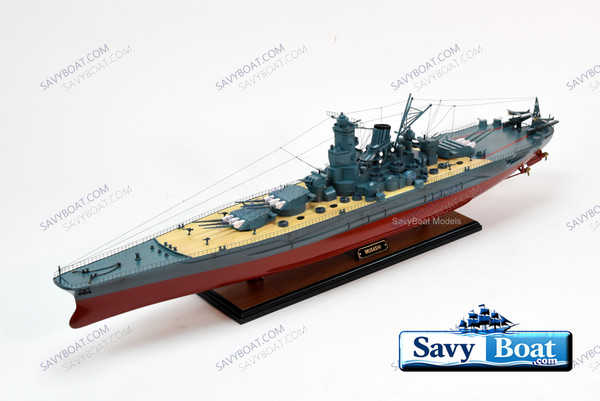

MUSASHI JAPANESE battleship 39" fully built wood model with stand
SAVY DIRECT PRICE $899.96MSRP: $999.99JAPENESE BATTLESHIP MUSASHI FULLY BUILT AND READY TO DISPLAY MUSEUM QUALITY SHIP MODEL Dimension approx.: 39.5″ (long) x 6.5″ (wide) x 9.5″ (high). APPROX SCALE 1/350 This beautiful... -


USS BALAO submarine 40" fully built wood model with stand
SAVY DIRECT PRICE $899.96MSRP: $999.99USS BALAO SUBMARINE FULLY BUILT AND READY TO DISPLAY, QUALITY SHIP MODEL Dimension approx.: 39″ L x 4″ W x 10″ H This beautiful model is already built, NOT a kit. USS Balao (SS-285) and the... -


RMS BERENGARIA STEAMSHIP 39" fully built wood model with stand
SAVY DIRECT PRICE $1,099.96MSRP: $1,199.99RMS BERENGARIA STEAMSHIP FULLY BUILT AND READY TO DISPLAY, QUALITY SHIP MODEL Dimension Approx.: 39″ (long) x 4.5″ (wide) x 13″ (high). The model is already built, NOT a model ship...
Description

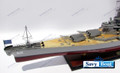
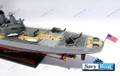
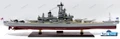
USS NEW JERSEY BATTLESHIP
FULLY BUILT AND READY TO DISPLAY MUSEUM QUALITY SHIP MODEL
- Dimension approx.: 40″ L x 5″ W x 12″ H
- This beautiful model is already built, NOT a kit.
USS New Jersey BB-62 (“Big J” or “Black Dragon”) is an Iowa-class battleship, and was the second ship of the United States Navy to be named after the US state of New Jersey. New Jersey earned more battle stars for combat actions than the other three completed Iowa-class battleships, and was the only US battleship providing gunfire support during the Vietnam War.
When USS New Jersey (BB‑62) slid down the ways on 7 December 1942, exactly one year after Pearl Harbor, she embodied the United States’ determination to seize the initiative in the Pacific. The second of the Iowa‑class fast battleships, she was built for a new kind of naval war — one where speed, long‑range gunnery, and carrier escort duty mattered as much as armor and brute force. With her nine 16‑inch/50 caliber Mark 7 guns, twenty 5‑inch dual‑purpose guns, and a forest of anti‑aircraft weapons, she was among the most formidable warships ever launched.
Commissioned in May 1943, New Jersey quickly joined the Fifth Fleet under Admiral Raymond Spruance. She screened carriers during the Marshall Islands campaign, bombarded Japanese positions on Kwajalein, Eniwetok, Saipan, and Tinian, and served as Spruance’s flagship during the devastating raid on Truk Lagoon in February 1944. Later that year, she helped guard the carriers during the Battle of the Philippine Sea, the “Marianas Turkey Shoot,” where Japanese naval aviation suffered catastrophic losses.
In August 1944, she became the flagship of Admiral William F. Halsey, commander of the Third Fleet, supporting operations across the Philippines, Formosa, and Okinawa. She endured typhoon winds during Typhoon Cobra in December 1944, emerging largely unscathed while three destroyers were lost. By war’s end, she had bombarded Okinawa, supported the first carrier strikes on Tokyo, and entered Tokyo Bay in September 1945 as part of the victorious U.S. fleet.
After the war, New Jersey served in training cruises and ceremonial duties before being decommissioned in 1948. But her career was far from over.
When war erupted in Korea in 1950, New Jersey was pulled from the reserve fleet and recommissioned. She arrived off Korea in May 1951 and spent months delivering devastating 16‑inch gunfire against North Korean positions — bridges, tunnels, supply depots, artillery sites, and troop concentrations. She served twice as flagship of the Seventh Fleet, earning a reputation as one of the most effective naval artillery platforms of the war.
Decommissioned again in 1957, she returned to service in 1968 during the Vietnam War. Stripped of her WWII‑era 20 mm and 40 mm guns and optimized for shore bombardment, she delivered heavy fire support along the Vietnamese coast before returning to the reserve fleet in 1969.
In the 1980s, as part of the U.S. Navy’s 600‑ship fleet initiative, New Jersey was modernized once more. She received Tomahawk cruise missiles, Harpoon anti‑ship missiles, and Phalanx CIWS defenses, transforming her into a hybrid of battleship firepower and modern missile capability. In 1983, she provided naval gunfire during U.S. operations in the Lebanese Civil War, firing her 16‑inch guns in combat for the last time.
After the Cold War wound down, New Jersey was decommissioned for the final time in 1991, having accumulated 19 battle and campaign stars — more than any other Iowa‑class battleship.
Following a brief period in reserve, New Jersey was donated to the Home Port Alliance and opened as a museum ship in Camden, New Jersey, on 15 October 2001. Today, visitors walk her teak decks, explore her turrets and missile systems, and stand in the spaces where Spruance and Halsey once directed the Pacific War.
From the Marshalls to Korea, from Vietnam to Lebanon, New Jersey served across five decades and four major conflicts — a battleship whose longevity, firepower, and adaptability made her one of the most storied warships in American naval history.