







-


RANGER SAILING YACHT
SAVY DIRECT PRICE $399.96MSRP: $469.99RANGER SAILING YACHT FULLY BUILT AND READY TO DISPLAY, HIGH QUALITY SHIP MODEL Dimension Approx.: 31.5L x 5W x 39.5H in The model is already built, NOT a model ship kit Whe -
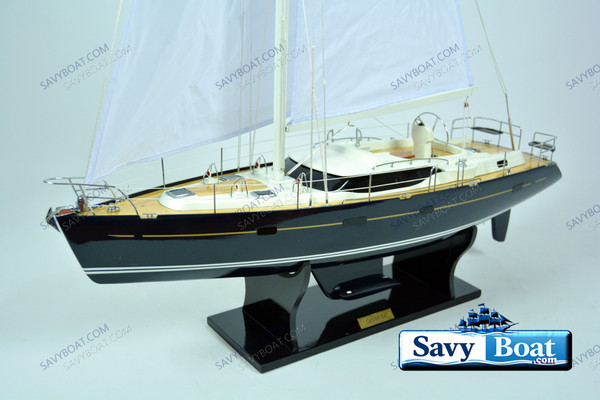

OYSTER 54 SAILING YACHT
SAVY DIRECT PRICE $689.96MSRP: $759.99OYSTER 54 SAILING YACHT FULLY BUILT AND READY TO DISPLAY, HIGH QUALITY SHIP MODEL Dimension Approx.: 32.25L x 9.5W x 48H The model is already built, NOT a model ship kit Introduc -
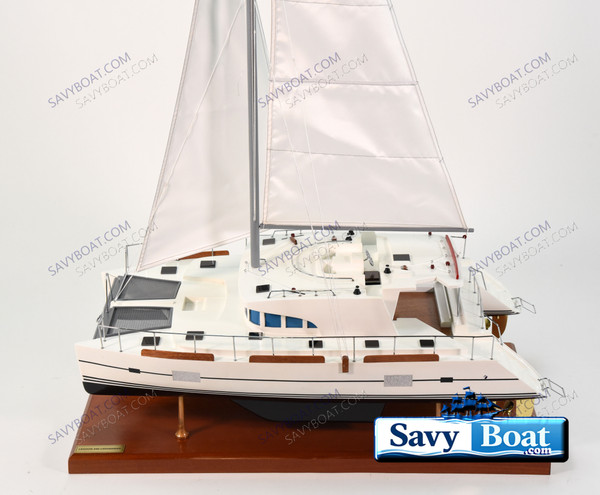

LAGOON 440 CATAMARAN SAILING YACHT
SAVY DIRECT PRICE $949.96MSRP: $999.99LAGOON 440 CATAMARAN SAILING YACHT FULLY BUILT AND READY TO DISPLAY MUSEUM QUALITY SHIP MODEL Dimension approx.: 28″ (long) x 16″ (wide) x 43″ (high) The model is already built. THIS IS...
Description

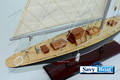
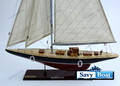
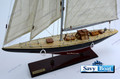
RAINBOW SAILING YACHT (PAINTED)
FULLY BUILT AND READY TO DISPLAY, HIGH QUALITY SHIP MODEL
- Dimension Approx.: 24L x 5.25W x 28.8H
- The model is already built, NOT a model ship kit
In the spring of 1934, as the Great Depression still cast long shadows across the world, a new racing yacht slid down the ways at the Herreshoff yard in Bristol, Rhode Island. She was called Rainbow, a name chosen by her owner, the patrician and fiercely competitive Harold S. Vanderbilt. Built in an astonishing 100 days, Rainbow was the latest expression of American yacht design—sleek, purposeful, and born for a single mission: to defend the America’s Cup.
Her designer, William Starling Burgess, had already proven himself a master of the J‑class, but Rainbow pushed his ideas further. She carried a pear‑shaped duralumin mast, a bold departure from the wooden spars of earlier defenders, and a bendable boom that allowed her crew to fine‑tune sail shape with unprecedented precision. Beneath her elegant overhangs and polished topsides lay a hull optimized for power and balance, the product of Burgess’s relentless experimentation.
Yet from the moment she was launched, Rainbow was overshadowed by whispers. The British challenger, Endeavour, designed by the brilliant Charles Nicholson and bankrolled by aviation magnate T.O.M. Sopwith, was widely considered the superior yacht. Endeavour was longer, stiffer, and faster in trials. Even American observers admitted that Rainbow might be outclassed. But Vanderbilt, a man who approached sailing with the same analytical rigor he brought to finance, believed that discipline, training, and flawless crew work could bridge the gap.
When the 1934 America’s Cup began off Newport, the contrast between the two syndicates became stark. Endeavour was a marvel of engineering, but her afterguard was plagued by internal friction and tactical missteps. Rainbow, by contrast, moved like a single organism. Vanderbilt’s crew drilled endlessly, their maneuvers crisp and almost military in their precision.
The series quickly turned dramatic. Endeavour won the first two races, confirming fears that Rainbow was outmatched. But in the third race, a controversial incident shifted the momentum: Endeavour failed to hoist a protest flag after a disputed maneuver, forfeiting her claim. The British team fumed; the Americans pressed on. Vanderbilt tightened his tactics, and Rainbow’s crew rose to the moment. Their tacks grew sharper, their spinnaker sets cleaner, their coordination nearly flawless.
Rainbow clawed her way back, race by race, until she stood level with Endeavour. In the decisive sixth race, she surged ahead on the final leg, her sails drawing cleanly in the afternoon breeze as the British challenger faltered. With that victory, Rainbow secured the Cup four races to two, preserving America’s unbroken defense and marking the first time a J‑class yacht had won the trophy.
After the triumph, Rainbow’s life quieted. She was laid up, then refitted as a trial horse, and eventually sold to Chandler Hovey for the 1937 defender trials—only to be overshadowed by the mighty Ranger. By 1940, with war looming and metal scarce, Rainbow was sold for scrap. Her racing days ended not with ceremony, but with the practical necessities of a world in turmoil.
Yet Rainbow’s legacy endured. She proved that victory in the America’s Cup was not solely the domain of the fastest hull, but of the best‑prepared crew and the most disciplined command. Her innovations influenced the next generation of J‑class yachts, and her 1934 defense became a defining chapter in the golden age of big‑boat racing.
Nearly eight decades later, a faithful replica of Rainbow emerged from a Dutch shipyard, her lines restored, her Art Deco interior reborn, and her performance enhanced by modern engineering. She sails today not as a relic, but as a living tribute to the yacht that once defied expectations and preserved a dynasty.
Rainbow remains, in every sense, a symbol of the elegance, rivalry, and relentless pursuit of perfection that defined the J‑class era.