






-
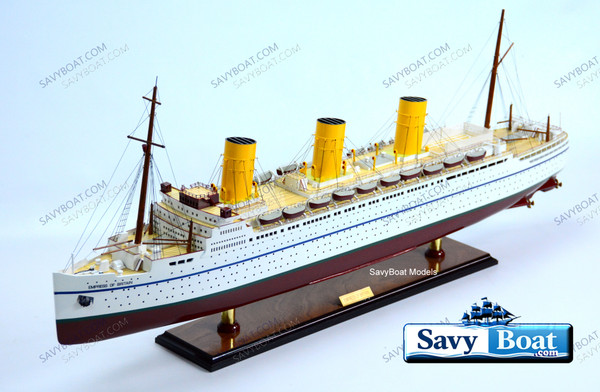

RMS EMPRESS OF BRITAIN
SAVY DIRECT PRICE $899.96MSRP: $999.99EMPRESS OF BRITAIN FULLY BUILT AND READY TO DISPLAY MUSEUM QUALITY SHIP MODEL Dimension approx.: 33″ L x 5.5″W x 13″ H Scale 1:250 The model is already built, NOT a model ship... -


RMS EMPRESS of FRANCE
SAVY DIRECT PRICE $1,199.96MSRP: $1,349.99RMS EMPRESS OF FRANCE, CANADIAN PACIFIC LINE (formerly Duchess of Bedford) FULLY BUILT AND READY TO DISPLAY MUSEUM QUALITY SHIP MODEL Dimension approx.: 36″ L x 5.5″W -


RMS EMPRESS OF IRELAND
SAVY DIRECT PRICE $999.96MSRP: $1,099.99RMS EMPRESS OF IRELAND, CANADIAN PACIFIC LINE FULLY BUILT AND READY TO DISPLAY MUSEUM QUALITY SHIP MODEL Dimension approx.: 36″ L x 5.5″W x 13″ H Scale 1:250 The model is already built,...
Description

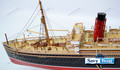
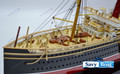
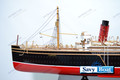
RMS CAMPANIA, CUNARD LINES STEAMSHIP
- Dimension Approx.: 32″ (long) x 4″ (wide) x 12″ (high)
- This is a fully built model. it is NOT a kit
When RMS Campania slid down the ways at Fairfield Shipbuilding in September 1892, she represented the height of Victorian ambition on the Atlantic. Built for the Cunard Line and designed alongside her sister ship Lucania, Campania was a bold statement of speed, engineering, and national pride. At more than 620 feet long and driven by two massive five‑cylinder triple‑expansion engines producing 31,000 horsepower, she was among the largest and fastest liners afloat. Her twelve Scotch boilers fed a hunger for steam that pushed her to service speeds of 22 knots—numbers that placed her squarely in the race for the coveted Blue Riband.
Her maiden season in 1893 confirmed her promise. On only her second westbound crossing, Campania seized the Blue Riband from the City of Paris, completing the voyage in under six days. On the return trip she shattered the eastbound record as well, covering the Atlantic in 5 days, 17 hours, and 27 minutes. For years she remained one of the most celebrated express liners of the North Atlantic, carrying up to 2,000 passengers across three classes. First‑class travelers enjoyed opulent Victorian interiors, while thousands of immigrants in steerage crossed the ocean in search of new lives. Campania was not just a ship—she was a bridge between continents.
Behind her commercial success lay a strategic purpose. Partly financed by the British Admiralty, Campania was built to naval reserve standards, her hull and machinery designed with the possibility of wartime conversion in mind. For two decades she served peacefully as a flagship of Cunard’s Liverpool–New York service, but the outbreak of World War I brought her naval destiny to the forefront.
In 1914, after being briefly sold for scrap, Campania was purchased by the Admiralty and transformed into one of the earliest aircraft carriers—an experimental platform for launching seaplanes. Her forward funnel was removed, two smaller ones added, and a flight deck installed along her bow. Renamed HMS Campania, she became a pioneering vessel in the evolution of naval aviation, supporting reconnaissance operations and training missions during the war.
Her end came not in battle but in a storm. On 5 November 1918, just days before the Armistice, a force‑10 squall tore through the Firth of Forth. Campania dragged her anchor and collided with two Royal Navy ships, including the battlecruiser Glorious. The impact tore open her hull, flooding the engine room. Within hours, the once‑proud liner slipped beneath the waves. Remarkably, all aboard escaped without loss of life.
Today, Campania rests on the seabed of the Firth of Forth, protected as a Historic Marine Protected Area. Her story endures as a testament to the ingenuity of late‑Victorian shipbuilding and the adaptability of ocean liners pressed into wartime service. From Blue Riband champion to early aircraft carrier, Campania’s life traced the dramatic arc of a world—and a maritime industry—on the brink of transformation.