




-

SEAWISE GIANT RC READY SUPERTANKER 45"
SAVY DIRECT PRICE $1,099.96MSRP: $1,189.99SEAWISE GIANT RC READY SUPER TANKER Dimension Approx.: 45L x 8.25W x 11.H (inch) This is a fully built model. it is NOT a kit RC READY - hatches open for easy installation of your RC... -


ULCC GIANT RC READY SUPER TANKER 72"
SAVY DIRECT PRICE $2,995.96MSRP: $3,379.99ULCC, GIANT, RC READY, SUPER TANKER 72" Dimension Approx.: 72in This is a fully built model. it is NOT a kit LIGHTED - LED LIGHTS pre-installed (power supply not included) RC READY -... -


JAHRE VIKING OIL RC READY TANKER
SAVY DIRECT PRICE $749.96MSRP: $799.99JAHRE VIKING OIL RC READY TANKER FULLY BUILT AND READY TO DISPLAY MUSEUM QUALITY SHIP MODEL Dimension approx.: 45″ L x 7.5″ W x 10″ H The model is already built. THIS IS NOT A MODEL...
Description

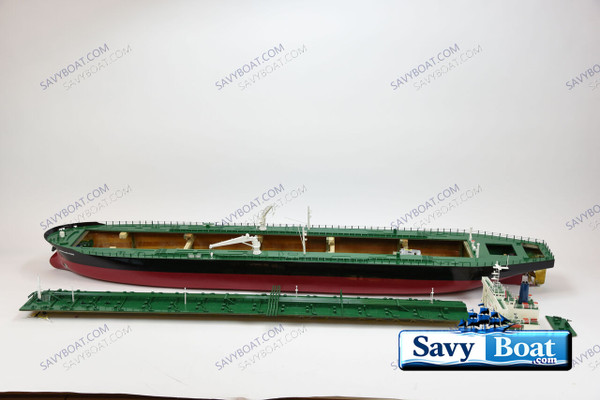
SEAWISE GIANT RC READY SUPERTANKER
- Dimension Approx.: 51″ L x 9″ W x 14″ H –
- Approx sscale 1:350
- This is a fully built model. it is NOT a kit
- RC READY - hatches open for easy installation of your RC equipment, propeller(s) and motor (not included)
When the Seawise Giant finally entered service in 1979, she was less a ship and more a moving horizon. At 458 meters from bow to stern, she stretched farther than the eye comfortably followed, a steel continent built to carry the lifeblood of modern industry. Her deck alone covered more than 31,000 square meters—an expanse so vast that crew members joked it had its own weather. Beneath that deck lay 46 cargo tanks capable of holding over four million barrels of crude oil, a capacity unmatched before or since.
Her story began awkwardly. Ordered as Oppama by Greek magnate Stavros Niarchos, she emerged from the Sumitomo shipyard with severe vibration problems that caused the buyer to reject her outright. For a time she sat idle, an unfinished giant without a name or purpose. It was C.Y. Tung, the visionary Hong Kong shipping magnate, who saw potential where others saw a costly mistake. He purchased the vessel, lengthened her through a massive jumboisation project, and christened her Seawise Giant—a play on his initials, C.Y.S.
Once completed, she was too large for the Suez Canal, too deep for the Panama Canal, and too wide for the English Channel. She existed in a category of her own: an Ultra Large Crude Carrier that could only move through the world’s deepest, widest waters. Powered by a 50,000‑horsepower steam turbine, she cruised at 16.5 knots, needing nine kilometers to stop and three kilometers to turn—distances that spoke to her sheer mass.
For nearly a decade she hauled crude oil between the Middle East and the United States, a steel artery connecting continents. But in 1988, during the Iran‑Iraq War, her luck ran out. Anchored off Larak Island, she was struck by Iraqi Exocet missiles. Flames engulfed her decks, and the world’s largest ship settled into shallow waters, declared a constructive total loss. It seemed an ignoble end for such a titan.
Yet the Seawise Giant refused to disappear. After the war, Norwegian investors salvaged the wreck and towed it to Singapore for repairs. Reborn as Happy Giant, she returned to service in 1991. Later that same year she was purchased by Jørgen Jahre and renamed Jahre Viking, sailing under the Norwegian flag for more than a decade. In 2004 she entered her final working life as Knock Nevis, a floating storage and offloading unit anchored off Qatar’s Al Shaheen Oil Field.
Only in 2009, renamed Mont, did she make her final voyage—this time to the ship‑breaking beaches of Alang, India. There, over the course of 2010, the world’s largest ship was taken apart piece by piece. Her 36‑ton anchor survives today at the Hong Kong Maritime Museum, a silent monument to a vessel that pushed the limits of what humans could build.
The Seawise Giant remains the longest and heaviest self‑propelled ship ever constructed, a record unlikely to be challenged. Her life—marked by engineering triumph, wartime destruction, improbable resurrection, and eventual dismantling—stands as a testament to the extremes of maritime ambition and the forces that shape the world’s oceans.