






-


SS GRIPSHOLM OCEAN LINER
SAVY DIRECT PRICE $899.96MSRP: $999.99SS GRIPSHOLM 1957 STEAM SHIP/OCEAN LINER FULLY BUILT AND READY TO DISPLAY, QUALITY SHIP MODEL Dimension approx.: 40″ (long) x 4.75″ (wide) x 12″ (high) This beautiful model is already built,... -
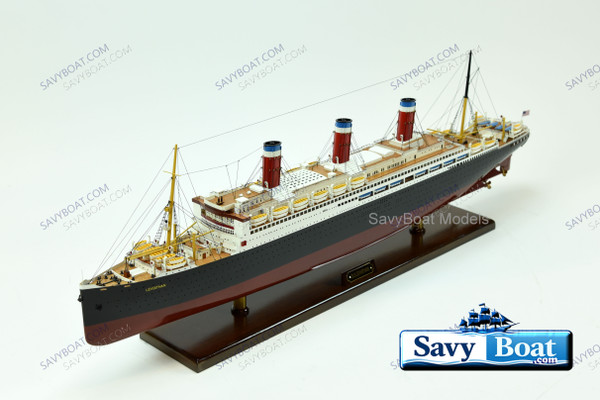
SS LEVIATHAN OCEAN LINER
SAVY DIRECT PRICE $999.96MSRP: $1,049.99SS LEVIATHAN OCEAN LINER FULLY BUILT AND READY TO DISPLAY BOAT MODEL Dimension approx.: 38″ L x 4.5″ W x 12″ H Approx Scale 1/300 The model is already built. THIS IS NOT A MODEL -
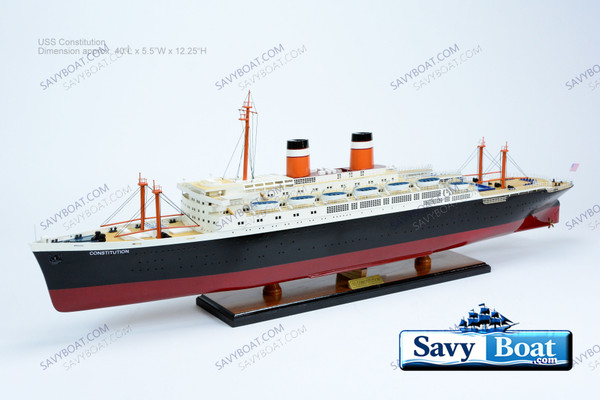

SS CONSTITUTION OCEAN LINER
SAVY DIRECT PRICE $799.96MSRP: $849.99SS CONSTITUTION OCEAN LINER FULLY BUILT AND READY TO DISPLAY BOAT MODEL Dimension approx.: 40"L x 6.5"W x 13.5"H The model is already built. THIS IS NOT A MODEL SHIP KIT The SS...
Description

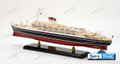
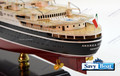
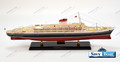
SS ANDREA DORIA OCEAN LINER
FULLY BUILT AND READY TO DISPLAY, QUALITY SHIP MODEL
- Dimension approx.: 34″ L x 4.75″ W x 11.5″ H
- Approx. Scale 1/250.
- The model is already built. THIS IS NOT A MODEL SHIP KIT
SS Andrea Doria — The Last Great Tragedy of the Ocean‑Liner Era
When the SS Andrea Doria entered service in 1953, she was more than a ship — she was Italy’s triumphant return to the world stage after the devastation of World War II. Sleek, modern, and adorned with over a million dollars’ worth of art, she embodied national pride and the glamour of transatlantic travel. At 29,100 gross tons and capable of carrying more than 1,200 passengers in three meticulously separated classes, she was the Italian Line’s crown jewel: fast, elegant, and — as her builders claimed — “the safest ship afloat.”
But in the summer of 1956, in the fog‑shrouded waters off Nantucket, the Andrea Doria would become the centerpiece of one of the most dramatic maritime disasters of the 20th century.
Designed by architect Giulio Minoletti, the Andrea Doria was a masterpiece of mid‑century Italian style. Her first‑class ballroom glittered with chandeliers, her dining rooms were lined with murals, and her decks offered swimming pools, promenades, and lounges for each passenger class. She was not the fastest liner on the Atlantic — that honor belonged to the SS United States — but she was among the most luxurious.
Beneath her beauty, however, lay hidden vulnerabilities. Her fuel tanks, when empty, made her top‑heavy. Her watertight bulkheads rose only to A Deck, not high enough to contain flooding if the ship developed a severe list. And her lifeboats could only be launched safely if the ship leaned less than 15 degrees.
These flaws would prove fatal.
On July 17, 1956, the Andrea Doria departed Genoa on her 51st westbound voyage to New York. She carried 1,134 passengers — from movie stars like Ruth Roman to emigrant families seeking new lives in America — and a crew of 572. After stops in Cannes, Naples, and Gibraltar, she steamed into the North Atlantic, bound for New York.
Meanwhile, the Swedish liner MS Stockholm had departed New York on July 25, heading east. Smaller and more utilitarian than the Italian ship, she was navigating clear weather — but she had strayed north of the recommended eastbound track, placing her directly in the path of westbound traffic.
The Andrea Doria, by contrast, had been enveloped in thick fog for hours.
Shortly after 11:00 p.m. on July 25, the two ships detected each other on radar. Misreadings, misinterpretations, and opposite assumptions about passing maneuvers set them on a deadly course. Neither ship made radio contact. Neither slowed enough.
At 11:10 p.m., the Stockholm burst out of the fog — too close to avoid disaster.
Her ice‑reinforced bow struck the Andrea Doria at nearly a right angle, tearing a 40‑foot gash deep into the Italian liner’s starboard side. Five fuel tanks flooded instantly. Air trapped in the empty port tanks caused the ship to lurch violently to starboard.
Within minutes, she listed more than 20 degrees — enough to render half her lifeboats useless.
Despite the catastrophic damage, the Andrea Doria remained afloat for 11 hours, long enough for one of the greatest maritime rescues in history.
-
The freighter Cape Ann arrived first.
-
The U.S. Navy transport Private William H. Thomas and destroyer Edward H. Allen soon followed.
-
The Stockholm, though badly damaged, launched her own boats and took aboard hundreds.
-
And then, like a vision in the fog, the French liner Île de France appeared — brilliantly illuminated, her crew ready for mass rescue.
In total, 1,660 people were saved.
Only 46 lives were lost — a tragedy, but far fewer than the scale of the disaster might have claimed.
By morning, the Andrea Doria was dying. Her list increased steadily as water spilled over bulkheads never designed for such angles. Captain Piero Calamai, one of the last to leave, watched from a rescue ship as his proud liner rolled onto her starboard side.
At 10:09 a.m. on July 26, 1956, she slipped beneath the Atlantic, bow first, her port propeller rising briefly into the air before disappearing forever.
Aerial photographs of her final moments — captured by Harry A. Trask — would win the Pulitzer Prize.
The collision sparked lawsuits, investigations, and decades of debate. No official determination of fault was ever published; the Italian Line and Swedish American Line settled privately. But the disaster exposed flaws in radar interpretation, ship design, and fog navigation practices.
The wreck itself, resting at 240 feet, became a perilous magnet for divers — claiming more lives in the decades that followed.
Yet the Andrea Doria endures in memory as the last great ocean‑liner catastrophe, occurring just as air travel was beginning to eclipse transatlantic steamships. Her sinking marked the twilight of an era — the end of the age when glamorous liners ruled the sea.
Today, she is remembered not only for her tragic fate, but for the extraordinary rescue that saved nearly all aboard, a testament to seamanship, courage, and the enduring drama of the North Atlantic.