








-

SS AUSTRALIS LIGHTED STEAM SHIP
SAVY DIRECT PRICE $999.96MSRP: $1,099.99SS AUSTRALIS LIGHTED LUXURY LINER FULLY BUILT AND READY TO DISPLAY, QUALITY SHIP MODEL Dimension approx.: 34″ (long) x 5″ (wide) x 11″ (high) LIGHTER - LED lights installed (power supply not... -


SS NORMANDIE STEAM SHIP
SAVY DIRECT PRICE $1,099.96MSRP: $1,199.99FRENCH LINE, SS NORMANDIE STEAM SHIP FULLY BUILT AND READY TO DISPLAY QUALITY SHIP MODEL Dimension approx.: 34″ L x 5″ W x 11.5″ H Approx. Scale 1:350. This beautiful model... -

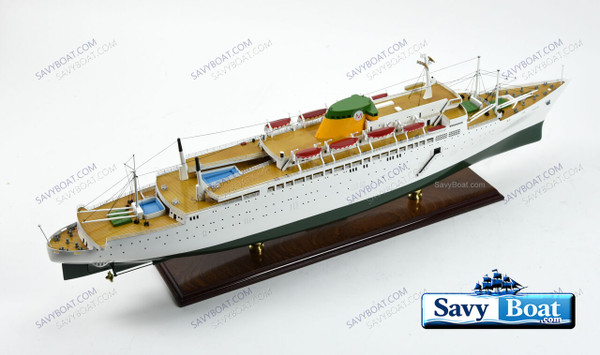
SS BRASIL STEAM SHIP
SAVY DIRECT PRICE $1,099.96MSRP: $1,199.99SS Brasil 1957, Moore-McCormack Lines FULLY BUILT AND READY TO DISPLAY MUSEUM QUALITY SHIP MODEL BEAUTIFUL MUSEUM QUALITY MODEL Open die cut side hull windows, NOT painted like those...
Description

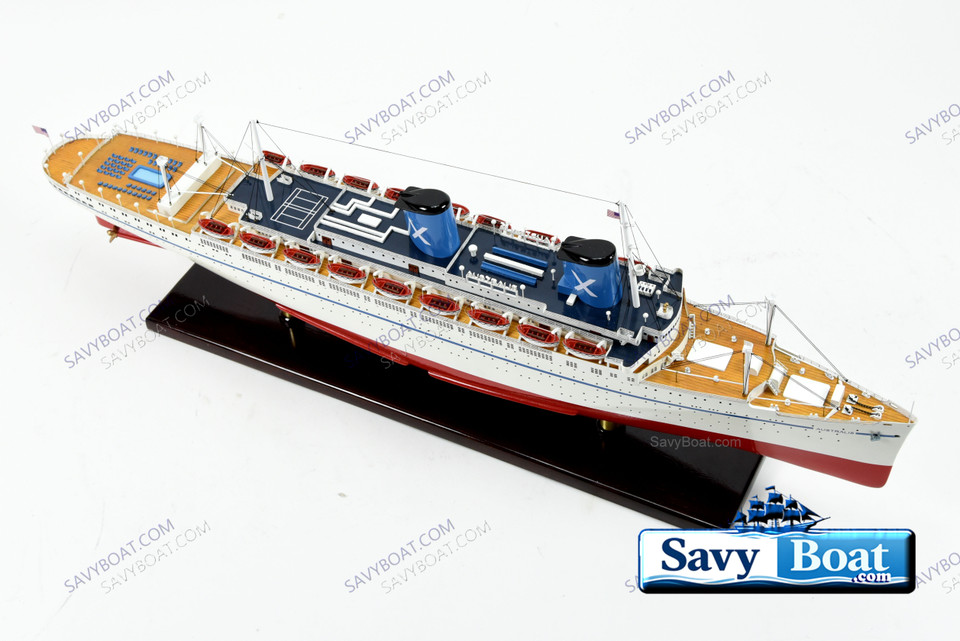
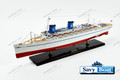
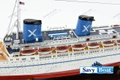
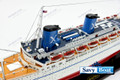
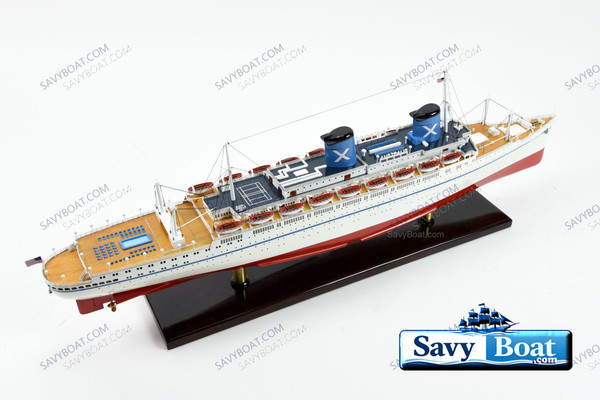
SS AUSTRALIS LUXURY LINER
FULLY BUILT AND READY TO DISPLAY, QUALITY SHIP MODEL
- Dimension approx.: 34″ (long) x 5″ (wide) x 11″ (high)
- This beautiful model is already built, NOT a kit.
-
Long before she became Australia’s most famous migrant ship, SS Australis began life as one of America’s great pre‑war liners. Launched in 1940 as SS America for United States Lines, she was the pride of designer William Francis Gibbs — a sleek, modern twin‑screw liner built for the North Atlantic, 723 feet long and capable of 22 knots. She was elegant, fast, and unmistakably American, a ship meant to symbolize confidence on the eve of a world at war.
America’s civilian career was brief. By 1941, she had been taken over by the U.S. Navy and converted into a troopship, carrying thousands of soldiers across the world’s oceans. One of her earliest wartime missions brought Australian troops from Egypt to Singapore, a moment that tied her fate — however faintly — to the southern hemisphere she would one day call home.
Returned to United States Lines in 1946, she resumed transatlantic service, carrying postwar travelers between New York and Europe. But by the early 1960s, the jet age was eroding the liner trade. In 1963, a labor strike laid her up, and her owners quietly began looking for a buyer.
That buyer was Antonios Chandris, whose young Chandris Line was rapidly expanding its migrant service between Europe and Australia. In October 1964, he purchased the ship for $4.25 million, renamed her SS Australis, and re‑registered her in Piraeus.
Over the next three years, Chandris transformed the ship completely. Her three‑class layout was stripped out and rebuilt into a single‑class migrant carrier. Her hull was repainted — first white, then grey for durability. Promenade decks were extended, air‑conditioning added, lifeboats increased, and a swimming pool installed. She emerged larger, brighter, and more spacious than ever before.
In 1965, Australis sailed from Piraeus on her maiden voyage to Australia, passing through the Mediterranean and the Suez Canal. She would make this journey countless times over the next decade.
For thousands of migrants from Greece, Italy, Germany, Britain, and beyond, Australis was the gateway to a new life. She became the largest post‑World War II migrant ship to regularly visit Australia, and her arrival in ports like Fremantle, Melbourne, and Sydney became a familiar and emotional sight.
Passengers remembered her Art Deco interiors, her vast public rooms, and the sense of adventure that came with a month‑long voyage. Some recalled Egyptian vendors paddling out to greet her in Cairo; others remembered the excitement of seeing Australia rise over the horizon for the first time.
By the mid‑1970s, she was a symbol of an era — the last great migrant liner still in service.
In 1977, she carried the final government‑assisted immigrants to Australia, closing a chapter in the nation’s postwar history.
After the migrant era ended, Australis struggled to find a stable role. She was laid up in Timaru, New Zealand, in 1978, then briefly revived for cruising out of New York. But her age and size made her expensive to operate.
In the 1980s and 1990s, she passed through a series of owners and names:
-
Noga (Silver Moon Ferries, 1984)
-
A failed hotel‑ship project
-
Long periods laid up, deteriorating in port
Her once‑proud profile grew tired, her interiors outdated, her machinery unreliable.
In 1994, while under tow to the scrapyards of India, the ship broke free in heavy seas near Fuerteventura in the Canary Islands. She drifted onto the rocks, broke apart, and sank — a dramatic, sorrowful end for a ship that had carried so many hopes across the world.
For years, her wreck remained visible at low tide, a ghostly reminder of her former grandeur.
Today, SS Australis holds a special place in Australian maritime memory. She was more than a liner; she was a vessel of transformation, carrying families, dreams, and futures across oceans. Her story spans war, migration, reinvention, and loss — the full arc of a 20th‑century ocean liner’s life.
For the thousands who sailed aboard her, she remains unforgettable: a ship of beginnings, endings, and the long journey in between.
-