







-


SS BRASIL LIGHTED STEAM SHIP
SAVY DIRECT PRICE $1,199.96MSRP: $1,299.99LIGHTED SS Brasil 1957, Moore-McCormack Lines FULLY BUILT AND READY TO DISPLAY MUSEUM QUALITY SHIP MODEL Dimension approx.: 37.5″L x 5″W x 11.5″H BEAUTIFUL MUSEUM QUALITY... -


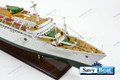
SS NORMANDIE STEAM SHIP
SAVY DIRECT PRICE $1,099.96MSRP: $1,199.99FRENCH LINE, SS NORMANDIE STEAM SHIP FULLY BUILT AND READY TO DISPLAY QUALITY SHIP MODEL Dimension approx.: 34″ L x 5″ W x 11.5″ H Approx. Scale 1:350. This beautiful model... -
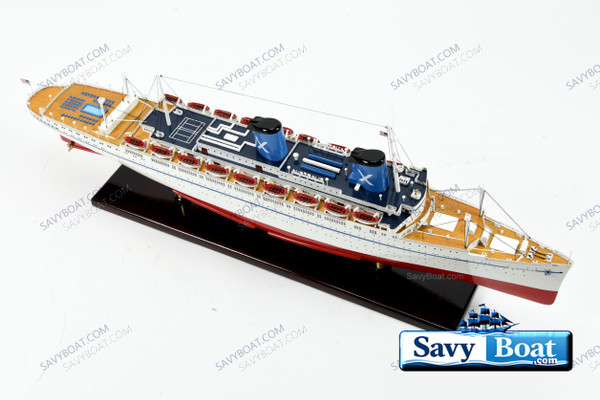
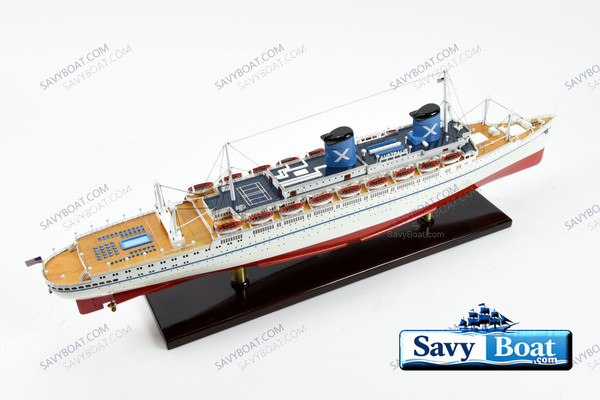
SS AUSTRALIS STEAM SHIP
SAVY DIRECT PRICE $899.96MSRP: $999.99SS AUSTRALIS LUXURY LINER FULLY BUILT AND READY TO DISPLAY, QUALITY SHIP MODEL Dimension approx.: 34″ (long) x 5″ (wide) x 11″ (high) This beautiful model is already built, NOT a kit. Long...
Description

SS Brasil 1957, Moore-McCormack Lines
FULLY BUILT AND READY TO DISPLAY MUSEUM QUALITY SHIP MODEL
- BEAUTIFUL MUSEUM QUALITY MODEL
- Open die cut side hull windows, NOT painted like those built by most other companies.
- Dimension approx.: 37.5″L x 5″W x 11.5″H
- The model is already built, NOT a model ship kit
- Handcrafted from scratch using finest woods & metal fittings
- Hand-painted to match the actual ship.
- APPROX SCALE 1:200
- The model is already built, NOT a model ship kit
SS Brasil was an ocean liner launched at Ingalls Shipbuilding in Pascagoula, Mississippi in 1957. Initially, the ship was originally named Brasil for Moore-McCormack’s South American service, but was renamed a number of times. During its history the ship served as a cruise ship and later served in the Semester at Sea program as Universe Explorer. The ship was scrapped in Alang, India, in 2004 sailing under the name Universe for the final voyage.
SS Brasil was a replacement for Moore-McCormack’s SS Brazil (1928). Brasil and her sister ship, Argentina, used MARAD Design P2-S2-9a of United States Maritime Administration. At the time of her construction, Brasil was said to be the largest ship built in the “deep south”
Ingalls Shipbuilding had the lowest US bid at $24,444,181 ($203 million today) for each of the two ships. The Maritime administration subsidized the cost of construction by paying $19,528,362 ($162 million today) to support the US shipbuilding industry. Meaning that the ships would have cost nearly $20 million less if they had been built outside the United States. As of 2015, Brasil and Argentina were among the last luxury liners built in the United States. Design included Denny-Brown stabilizers, a system of retractable fins in order to stabilize the ships in heavy seas. The ship design originally included a solarium for nude sun tanning inside the false funnel.
SS Brasil entered the world in 1957 beneath the humid Mississippi sky, sliding down the ways at Ingalls Shipbuilding as the largest vessel ever built in the Deep South—a gleaming new ambassador for Moore‑McCormack’s South American service. She carried the Portuguese‑spelled name Brasil at the request of the Brazilian ambassador, and from her maiden voyage in 1958 she embodied the optimism of postwar American shipbuilding: stabilizer fins for steady seas, a whimsical nude‑sunbathing solarium hidden inside her false funnel, and interiors filled with murals, lounges, and cinematic mid‑century glamour. Over the decades she became a wanderer of identities—Volendam, Liberte, Canada Star, Queen of Bermuda, Enchanted Seas—each new name marking another chapter as she passed from Holland America to American Hawaii Cruises, to Bermuda Star Line, to Commodore. She carried refugees, tourists, students, and dreamers; she survived a marijuana‑laden pipe strapped secretly to her hull, a deadly laundry‑room fire in Alaska, and a violent collision on the Saigon River. In her final incarnation as Universe Explorer, she circled the globe with Semester at Sea, a floating campus filled with young travelers discovering the world from her decks. But time eventually claimed her: structural disputes ended her service in 2004, and she made one last voyage under the simple name Universe, beaching herself at Alang where the tide delivered her to the breakers. Piece by piece, the ship that had once carried the hopes of American shipbuilding disappeared into history—yet her many names, many lives, and many seas remain part of her legend.
Now you can get this beautiful model in your own home or office. You can find many details of the model such as: All windows, doors, and portholes are cut out precisely thanks to hand-built hollow superstructure and hull; Open promenade decks visible through superstructure windows; Lattice grating on ducts and vents; Detail lifeboats hung from launching davits; Delicate railings on forecastle, aft castle and top superstructure; Rigging and stay-lines on all masts and smokestacks. Furthermore, we applied multi-layered paint to match the color of the real ship.