









-


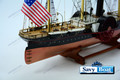
SS AMERICA OCEAN LINER
SAVY DIRECT PRICE $699.96MSRP: $749.99SS AMERICA OCEAN LINER FULLY BUILT AND READY TO DISPLAY BOAT MODEL Dimension approx.: 40″ L x 6″ W x 12.5″ H The model is already built. THIS IS NOT A MODEL SHIP KIT When the SS... -


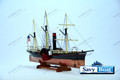
USS SUSQUEHANNA SIDE WHEEL PADDLE STEAMER
SAVY DIRECT PRICE $699.96MSRP: $799.99USS SUSQUEHANNA SIDE WHEEL PADDLE STEAMER FULLY BUILT AND READY TO DISPLAY QUALITY SHIP MODEL Dimension Approx.: 38″ (high) x 10.5″ (wide) x 28″ (high) The model is already built, -


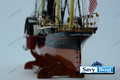
USS POWHATAN SIDE WHEEL STEAMSHIP W/ SAILS
SAVY DIRECT PRICE $799.96MSRP: $799.99USS POWHATAN SIDE WHEEL STEAMSHIP W/ SAILS FULLY BUILT AND READY TO DISPLAY QUALITY SHIP MODEL Dimension Approx.: 32″ (high) x 8″ (wide) x 28.5″ (high) The model is already built,
Description

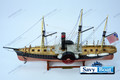
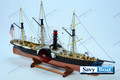
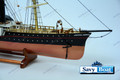
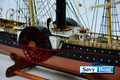
SS CENTRAL AMERICA SIDE WHEEL, PADDLE STEAMER
FULLY BUILT AND READY TO DISPLAY BOAT MODEL
- Dimension approx.: 27″ (long) x 5″ (wide) x 17″ (high)
- The model is already built. THIS IS NOT A MODEL SHIP KIT
The SS Central America, originally launched in 1852 as the SS George Law, was one of the most important American steamships of the mid‑19th century. Built at the Webb shipyard in New York for the United States Mail Steamship Company, she was a 280‑foot sidewheel steamer designed to serve the crucial Panama–San Francisco mail route. Renamed Central America to reflect her role in linking the East Coast with the booming California frontier, she quickly became the lifeline of the Gold Rush economy — carrying passengers, mail, and immense quantities of gold from the Pacific to the Atlantic.
Her design reflected the transitional era of steam navigation: 26‑foot paddle wheels, a 250‑horsepower side‑lever engine from Novelty Works, auxiliary sails for long passages, and a burden of roughly 1,100 tons. She was one of the earliest steamers to regularly cross into the Pacific, helping knit together a nation expanding westward at breakneck speed.
On September 3, 1857, the SS Central America departed Colón, Panama with 477 passengers and 101 crew, many of them miners returning home with fortunes from the gold fields. Her cargo included an estimated 30,000 pounds of gold — coins, bars, nuggets, and dust — worth about $1 million in 1857 and hundreds of millions today. After stopping in Havana, she headed north toward the United States.
On September 9, disaster struck. Off the Carolinas, the ship encountered a Category 2 hurricane. Towering seas shredded her sails, and a leak near the paddle‑wheel shaft allowed water to pour in. As her coal bunkers dwindled, she grew dangerously top‑heavy. By September 11, her boiler failed, steam pressure collapsed, and the paddle wheels froze. Passengers and crew formed desperate bucket brigades, fighting to keep her afloat as the storm raged.
Captain William Lewis Herndon, a respected U.S. Navy officer, oversaw an orderly evacuation, placing women and children into lifeboats. The brig Marine rescued about 100 survivors, but most remained aboard as the storm intensified. On the morning of September 12, at roughly 8:00 a.m., the SS Central America succumbed to the sea. 425 lives were lost. A Norwegian barque, Ellen, later rescued 50 more, and three additional survivors were found a week later.
The tragedy sent shockwaves across the nation. The sudden loss of so much gold — combined with the human catastrophe — helped trigger the Panic of 1857, one of the first major financial crises in U.S. history. For decades, the wreck lay undisturbed in deep water until 1988, when treasure hunter Tommy Thompson located the site and recovered roughly two tons of gold, igniting a long legal and financial saga that continues to this day.
Today, the SS Central America is remembered as the “Ship of Gold” — a symbol of both the promise and peril of the Gold Rush era. Her sinking remains one of the deadliest maritime disasters in early American history, a story of courage, loss, and the fragile fortunes of a nation built on ambition and risk.