



-
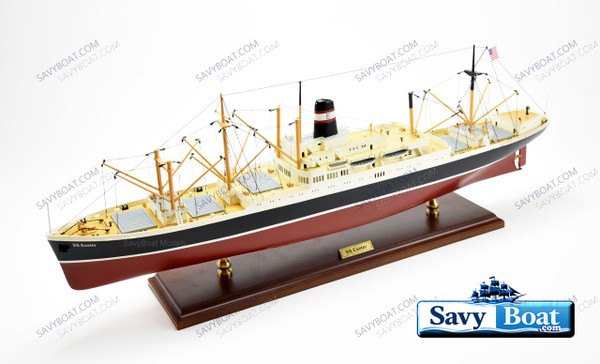
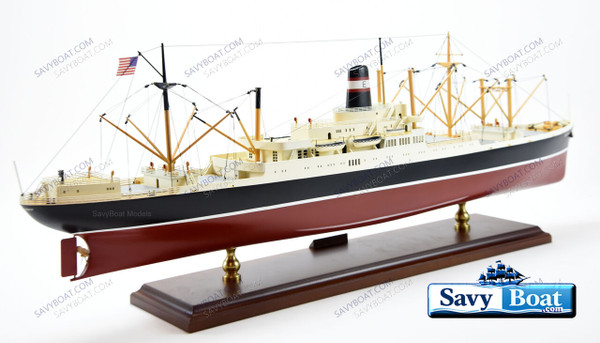
SS EXETER PASSENGER CARGO SHIP
SAVY DIRECT PRICE $1,449.96MSRP: $1,599.99SS EXETER PASSENGER/CARGO SHIP FULLY BUILT AND READY TO DISPLAY, QUALITY SHIP MODEL Dimension Approx.: 35″L x 5.5″W x 12.5″H SCALE 1:300 The model is already built, NOT a model ship kit -
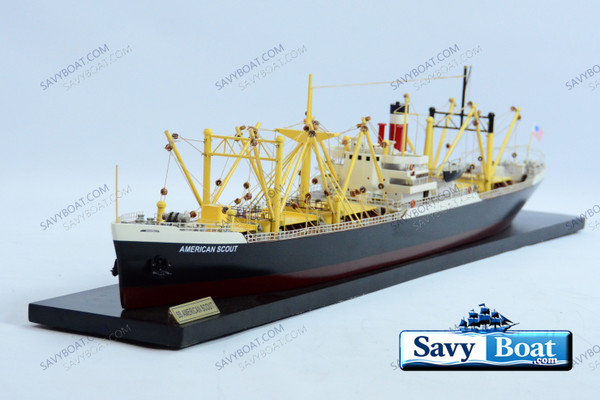

SS AMERICAN SCOUT CARGO SHIP WATERLINE MODEL
SAVY DIRECT PRICE $659.96MSRP: $699.99SS AMERICAN SCOUT CARGO SHIP WATERLINE MODEL FULLY BUILT AND READY TO DISPLAY, QUALITY SHIP MODEL Dimension approx.: 35″ L x 5″ W x 11″ H The model is already built. THIS IS NOT A... -


SS AMERICAN SCOUT RC WWII CARGO SHIP
SAVY DIRECT PRICE $1,299.96MSRP: $1,399.99SS AMERICAN SCOUT RC READY WWII C2-S -AJ5 CLASS CARGO SHIP FULLY BUILT AND READY TO DISPLAY MUSEUM QUALITY SHIP MODEL Dimension approx.: 35″ L x 5″ W x 11″ H LIGHTED - LED LIG
Description

AMERICAN EXPORT LINES SS EXCALIBUR (Joseph Hewes)
FULLY BUILT AND READY TO DISPLAY SHIP MODEL
- Dimension Approx.: 36″ (long) x 5″ (wide) x 9″ (high)
- The model is already built. THIS IS NOT A MODEL SHIP KIT
When the SS Excalibur entered service in 1930, she embodied the optimism and elegance of a world still in love with ocean travel. Built by the New York Shipbuilding Company and designed by George G. Sharp, she was one of American Export Lines’ famed “Four Aces”—a quartet of modern passenger‑cargo liners created to serve the Mediterranean with speed, comfort, and style. Her interiors, crafted under the direction of industrial designer Henry Dreyfuss, blended clean lines with Mediterranean motifs, giving the ship a refined, contemporary character. Every stateroom was first‑class, every cabin air‑conditioned, and every detail designed to make the long voyage from New York to Europe feel effortless.
Her maiden voyage on 24 January 1931 carried her to Marseille, Naples, Alexandria, Jaffa, Haifa, and Beirut, establishing a route she would follow faithfully throughout the decade. Diplomats, artists, businessmen, and tourists favored her for her comfort and reliability. Even in turbulent times, she remained a ship of distinction. In 1940, she carried the Duke and Duchess of Windsor from Lisbon to the Bahamas, and later that year she was intercepted in Bermuda by the Royal Navy, who seized hundreds of valuable paintings hidden aboard—an episode that underscored the growing tension in Europe.
As the United States entered World War II, the era of luxury liners came to an abrupt end. In January 1942, the Navy acquired Excalibur and converted her into a troop transport. Renamed USS Joseph Hewes (AP‑50), she traded her elegant lounges and staterooms for barracks, cargo holds, and military equipment. Her mission was no longer to carry travelers to Mediterranean ports, but to deliver soldiers into battle.
Assigned to the Center Attack Group of Admiral Hewitt’s Western Naval Task Force, she became part of the Allied plan to invade North Africa. On 24 October 1942, she departed Hampton Roads with more than 1,100 troops of the reinforced 3rd Infantry Division, along with ammunition and supplies essential to Operation Torch.
On 11 November 1942, anchored in Fedala Roads off the Moroccan coast, Joseph Hewes was struck by a torpedo fired by the German submarine U‑173. The explosion tore through her hull, and despite efforts to save her, the ship sank quickly. All aboard were lost. The tragedy marked one of the earliest American naval losses of the North African campaign and brought a sudden, violent end to a ship that had once been a symbol of peaceful travel.
Of the Four Aces, only SS Exochorda survived the war to return to civilian life. Yet Excalibur’s story remains one of the most compelling—an elegant liner transformed into a vessel of war, her peaceful origins overshadowed by the demands of global conflict. Her life captures the dual identity of many ships of her era: ambassadors of culture in peacetime, instruments of national duty in wartime.
The Excalibur sailed the Mediterranean with grace, carried royalty across the Atlantic, and ultimately gave her life in service to her country. Her story endures as a testament to the ships that bridged two worlds—one of luxury and one of war.