










-


SS AMERICA OCEAN LINER
SAVY DIRECT PRICE $699.96MSRP: $749.99SS AMERICA OCEAN LINER FULLY BUILT AND READY TO DISPLAY BOAT MODEL Dimension approx.: 40″ L x 6″ W x 12.5″ H The model is already built. THIS IS NOT A MODEL SHIP KIT When the SS... -
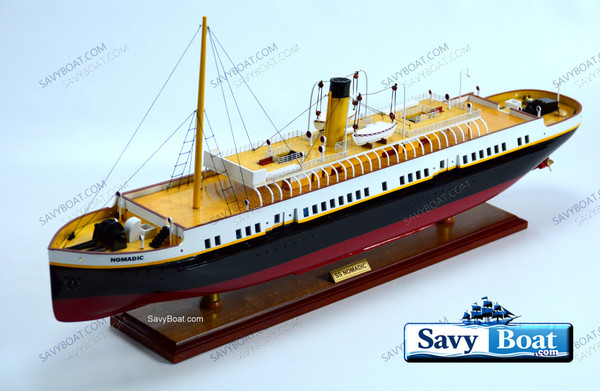
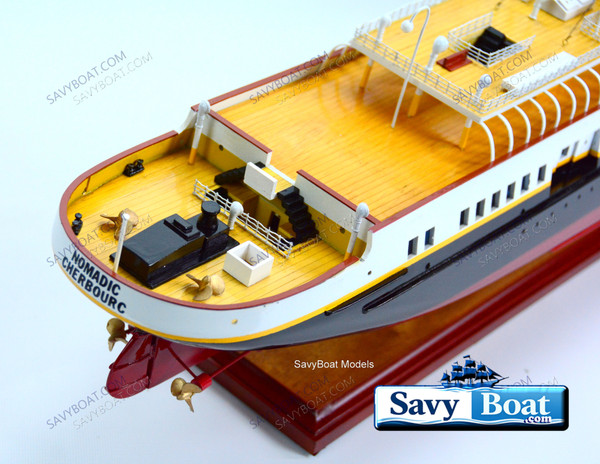
SS NOMADIC OCEAN LINER
SAVY DIRECT PRICE $699.96MSRP: $749.99SS NOMADIC OCEAN LINER FULLY BUILT AND READY TO DISPLAY BOAT MODEL Dimension approx.: 34"L x 6"W x 15"H The model is already built. THIS IS NOT A MODEL SHIP KIT -


SS RAFFAELLO OCEAN LINER
SAVY DIRECT PRICE $999.96MSRP: $1,099.99SS RAFFAELLO OCEAN LINER FULLY BUILT AND READY TO DISPLAY, HIGH QUALITY SHIP MODEL Dimension Approx.: 36.5″ L x 4.5″ W x 11.5″ H Approx Scale 1:300
Description

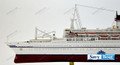
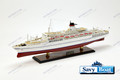
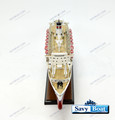
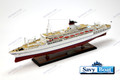
SS GUGLIELMO MARCONI OCEAN LINER
FULLY BUILT AND READY TO DISPLAY BOAT MODEL
- Dimension approx.: 34″ L x 5″ W x 12″ H
- Appox Scale: 1:250
- The model is already built. THIS IS NOT A MODEL SHIP KIT
Launched on 24 September 1961 from the Cantieri Riuniti dell’Adriatico shipyard in Monfalcone, the SS Guglielmo Marconi was one of Italy’s most advanced postwar ocean liners. Built for Lloyd Triestino and completed in October 1963, she was the sister ship to the SS Galileo Galilei, forming the modern Galileo‑class that replaced the aging Australia‑class vessels on the Italy–Australia migrant route. Her design reflected the optimism and engineering ambition of early‑1960s Italian shipbuilding: sleek, fast, and unmistakably modern.
Marconi departed on her maiden voyage on 18 November 1963, sailing from Genoa to Sydney. She offered a dramatically shorter 23‑day trans‑Tasman crossing, compared to the month‑long voyages of her predecessors. With accommodations for 156 first‑class passengers, 994 tourist‑class passengers, and a crew of 443, she was built to carry thousands of migrants and travelers seeking new lives or new horizons in Australia. Her bulbous bow, sculpted funnel with disperser fin, and telescopic exhaust pipe were cutting‑edge features that gave her a futuristic profile and excellent seakeeping.
From 1963 to 1976, Marconi served the Genoa–Sydney route, sailing through the Suez Canal eastbound and returning via the Panama Canal or Cape of Good Hope depending on political conditions. She became a familiar sight in Australian ports, carrying generations of migrants who would shape the nation’s cultural landscape. Her speed — 24 knots — and Italian hospitality made her one of the most admired liners of the era.
In 1976, shifting migration patterns and rising air travel led Lloyd Triestino to transfer Marconi to the Italian Line, where she operated the Naples–Brazil–River Plate route. Three years later, in 1979, she was sold to Italia Crociere Internazionali and converted into a full‑time cruise ship. The venture struggled, and in 1983 she was sold to Costa Cruises, beginning the transformation that would define her later life.
After a two‑year rebuild, she reemerged in 1985 as Costa Riviera, a modern cruise ship with updated interiors and new amenities. For nearly a decade, Costa Riviera alternated between Caribbean and Alaskan cruises, becoming a popular vessel in Costa’s expanding fleet.
In 1993, she was chartered to American Family Cruises and renamed American Adventure, part of a short‑lived attempt to create a family‑focused U.S. cruise brand. The venture collapsed within a year, and Marconi returned to Genoa in September 1994, resuming service as Costa Riviera until 2001.
After nearly four decades at sea, the ship was sold for scrap under the name Liberty and dismantled in March 2002 — ending a long, varied, and influential career.
As built, Marconi measured 701 feet (213.7 m) in length, with a 94‑foot beam, 27,905 GRT, and twin‑screw geared turbines capable of 24 knots. She was a product of Italy’s postwar maritime renaissance, evolving from a high‑speed migrant liner into a versatile cruise ship that sailed Europe, the Americas, and the Pacific.
Today, the SS Guglielmo Marconi is remembered as a pioneering vessel of the migrant era and a symbol of Italian innovation. Her transformation across multiple owners and identities reflects the changing demands of ocean travel in the late 20th century — from mass migration to global leisure cruising — and her legacy endures as one of the most distinctive and adaptable liners of her generation.