






-
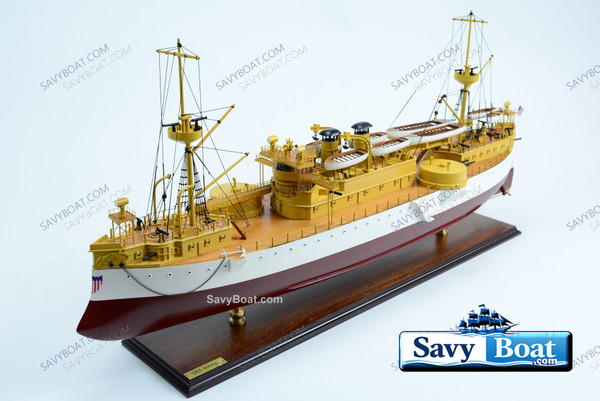
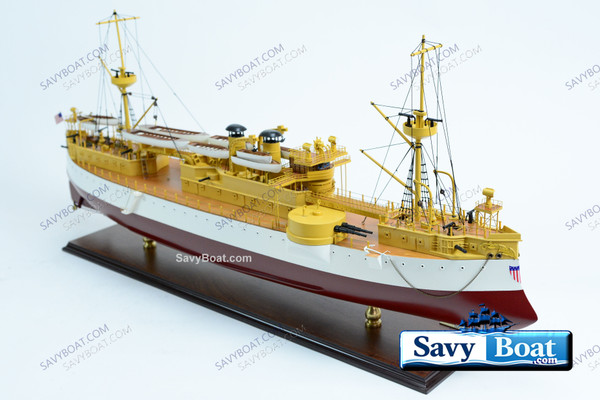
USS MAINE BATTLESHIP
SAVY DIRECT PRICE $849.96MSRP: $899.99USS MAINE SECOND CLASS BATTLESHIP FULLY BUILT AND READY TO DISPLAY, QUALITY SHIP MODEL Dimension Approx.: 32″L x 6.5″W x 14″H The model is already built, NOT a model ship kit Approximate scale... -
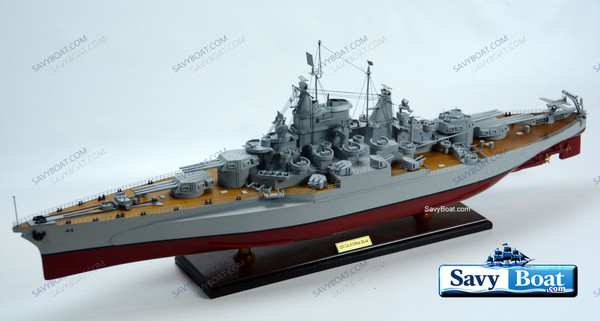

USS CALIFORNIA BATTLESHIP
SAVY DIRECT PRICE $849.96MSRP: $899.99USS CALIFORNIA BATTLESHIP FULLY BUILT AND READY TO DISPLAY QUALITY SHIP MODEL BEAUTIFUL MUSEUM QUALITY MODEL Dimension approx.: 37.5″ L x 7″ W x 14″ H USS California (BB‑44), the second of... -
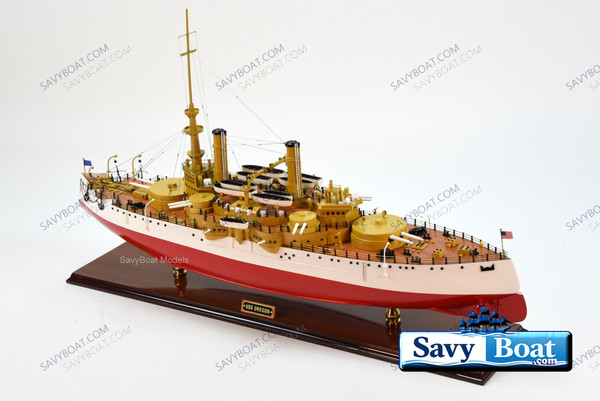
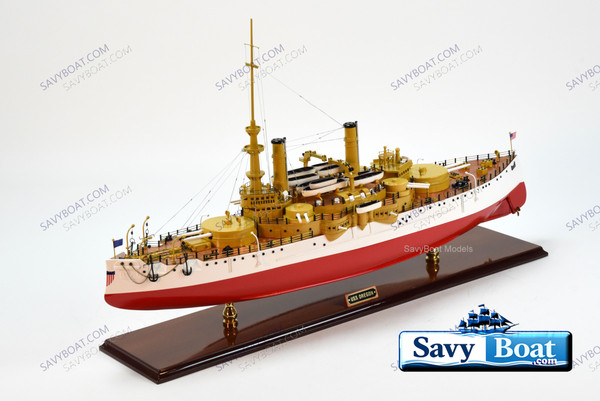
USS OREGON BATTLESHIP BB-3
SAVY DIRECT PRICE $924.96MSRP: $999.99USS OREGON BATTLE SHIP BB-3 (YELLOW) FULLY BUILT AND READY TO DISPLAY, QUALITY SHIP MODEL Dimension approx.: 34″ L x 8.5″ W x 20″ H
Description

USS OLYMPIA BATTLESHIP
FULLY BUILT AND READY TO DISPLAY, QUALITY SHIP MODEL
- Dimension Approx.: 36″ L x 5″ W x 18″ H
- The model is already built, NOT a model ship kit
Admiral Dewey’s Flagship USS Olympia
When USS Olympia slid down the ways at Union Iron Works in San Francisco in 1892, she represented the boldest ambitions of a young, modernizing U.S. Navy. Fast, heavily armed, and protected by the latest Harvey steel, she was the most advanced cruiser ever built on the West Coast — a symbol of America’s shift from coastal defense to global presence. No one could have predicted that she would become one of the most storied ships in American history, nor that she would survive into the 21st century as the oldest steel warship still afloat.
In the late 1880s, the United States was rethinking its naval strategy. Commerce raiding and coastal defense were giving way to Alfred Thayer Mahan’s vision of a blue‑water battle fleet. Olympia was conceived in this transitional moment — a large, fast protected cruiser armed with four 8‑inch guns, ten 5‑inch casemate guns, and a battery of rapid‑fire weapons. Her 21‑knot speed, triple‑expansion engines, and sloped armored deck made her one of the most formidable cruisers of her era.
Commissioned in 1895, she became flagship of the Asiatic Squadron, a role that would place her at the center of a war that reshaped American history.
When war with Spain erupted in April 1898, Commodore George Dewey hoisted his flag aboard Olympia. At dawn on 1 May, his squadron steamed into Manila Bay to confront the Spanish fleet. At 5:40 a.m., Dewey gave the order that would echo through naval history: “You may fire when you are ready, Gridley.”
The forward 8‑inch turret aboard Olympia fired the first American shot of the battle. Over the next several hours, Dewey’s squadron annihilated the Spanish fleet with minimal damage to their own ships. The victory made Dewey a national hero and Olympia a legend — the ship that announced the United States as a rising world power.
After supporting the Army ashore, Olympia returned home in triumph, her crew celebrated across the country.
Decommissioned after the war, Olympia returned to service in 1902, patrolling the Atlantic and Mediterranean and serving as a training ship for midshipmen. By 1912, she was a barracks ship in Charleston — an aging veteran of a bygone era.
But when the United States entered World War I, she was mobilized once more. She patrolled the East Coast, escorted convoys, and in 1918 carried American forces to Murmansk during the Allied intervention in the Russian Civil War. After the Armistice, she served in the Mediterranean and Adriatic, projecting stability in a region torn apart by the collapse of empires.
In 1921, Olympia performed her most solemn duty. She sailed to Le Havre, France, to bring home the remains of the Unknown Soldier of World War I. The casket, too large to fit below decks, was secured on the weather deck beneath canvas as the cruiser crossed the storm‑tossed Atlantic.
On 9 November 1921, Olympia arrived at the Washington Navy Yard, where the Unknown Soldier was transferred ashore for interment at Arlington National Cemetery. It was the last great moment of her active career.
Decommissioned in 1922, Olympia was preserved as a relic — a rare honor in an era when most steel warships were quickly scrapped. In 1957, she became a museum ship in Philadelphia, restored to her 1898 appearance. But time was unkind. By the early 2000s, her hull had deteriorated so severely that scuttling was considered.
Instead, a coalition of donors, preservationists, and the Independence Seaport Museum rallied to save her. Millions were invested in emergency stabilization: hull reinforcement, rigging restoration, deck repairs, and new bilge systems. By 2017, the first major phase of repairs was complete, and a national campaign began to raise the funds needed for full dry‑docking and long‑term preservation.
Today, Olympia remains moored at Penn’s Landing — the sole surviving warship of the Spanish–American War fleet, the ship that fired the first shot at Manila Bay, and the vessel that carried home the Unknown Soldier. Her steel hull has weathered more than a century of storms, wars, and neglect, yet she endures as a tangible link to America’s emergence on the world stage.
She is not just a museum ship. She is a national memory — preserved in steel, history, and honor.