

















-


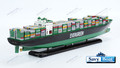
NYK LINE CONTAINER SHIP
SAVY DIRECT PRICE $899.96MSRP: $999.99NYK LINE CONTAINER SHIP FULLY BUILT AND READY TO DISPLAY MUSEUM, QUALITY SHIP MODEL Dimension approx.: 40L x 6.5W x 10H (inch) The model is already built. THIS IS NOT A MODEL SHIP... -


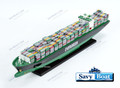
COSCO CONTAINER SHIP
SAVY DIRECT PRICE $899.96MSRP: $999.99COSCO CONTAINER SHIP FULLY BUILT AND READY TO DISPLAY MUSEUM QUALITY SHIP MODEL Dimension approx.: 40″ (long) x 7″ (wide) x 11″ (high) The model is already built. THIS IS NOT A... -
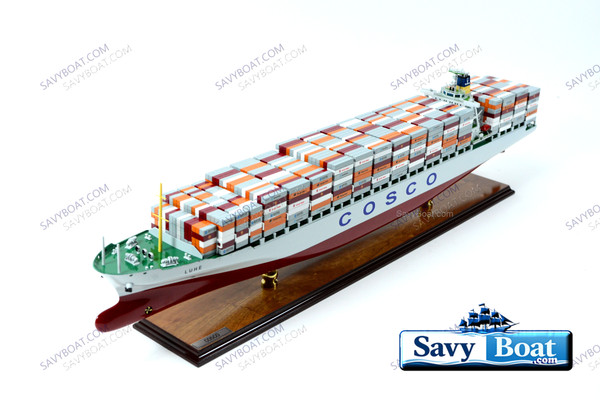

COSCO CONTAINER SHIP - EUROPE
SAVY DIRECT PRICE $899.96MSRP: $999.99COSCO CONTAINER SHIP - EUROPE FULLY BUILT AND READY TO DISPLAY MUSEUM SHIP MODEL Dimension approx.: 40L x 7W x11H (inches) The model is already built. THIS IS NOT A MODEL SHIP...
Description

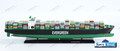
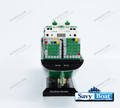
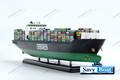
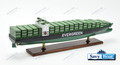
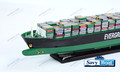
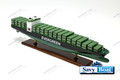
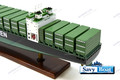
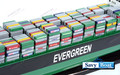
EVERGREEN LINE CONTAINER SHIP
FULLY BUILT AND READY TO DISPLAY SHIP MODEL
- Dimension Approx.: 27.5L x 3.5W x 8H (inch)
- The model is already built. THIS IS NOT A MODEL SHIP KIT
When Chang Yung‑fa founded Evergreen Marine Corporation on 1 September 1968, he began not with a fleet but with a single vessel—the Central Trust—and a philosophy that defied the conventions of the era. While most Asian carriers focused on fixed regional loops, Evergreen offered a bold “go‑anywhere” service, sending its lone ship wherever cargo needed to move. By 1969, a second vessel joined the operation, pushing into Middle East routes and signaling that Evergreen intended to grow not by caution, but by reach.
The company’s defining transformation came in 1975, during one of the worst global shipping downturns of the postwar era. As fuel prices soared and many carriers retreated, Evergreen did the opposite: it launched its first transpacific container service from the Far East to the U.S. East Coast. It was the first Taiwanese company to operate such a fleet, and the move positioned Evergreen at the forefront of the container revolution just as the world economy prepared to rebound. This willingness to expand against the tide became a hallmark of Evergreen’s rise.
By the 1980s, Evergreen was no longer a regional challenger but a global force. In 1984, it inaugurated its pioneering round‑the‑world container service, offering both eastbound and westbound loops that stitched together Asia, Europe, and the Americas in a continuous, two‑way circuit. The concept was refined and expanded through the early 1990s, and by 1993, Evergreen had become synonymous with global connectivity—one of the few carriers whose network truly encircled the planet.
The company’s growth accelerated again in 1997 with the formation of the Evergreen Group, consolidating its shipping, logistics, and transportation ventures under a single corporate umbrella. Diversification followed: in 2002, Evergreen entered the airline industry with EVA Air, extending the Evergreen name into the skies and reinforcing its identity as a multimodal transport empire.
By the late 1980s and early 1990s, Evergreen had already become the largest container carrier in the world, a position earned through relentless fleet expansion and a commitment to long‑haul, high‑frequency service. Today, Evergreen operates over 150 container ships, calling at 240 ports in roughly 80 countries. Its principal trade lanes—East Asia to North America, Europe, Australia, Africa, and South America—form some of the busiest arteries of global commerce.
Evergreen has also been a leader in the era of mega‑ships. Its A‑class vessels, built by Samsung Heavy Industries and China State Shipbuilding Corporation, rank among the largest container ships ever constructed, with capacities up to 24,004 TEU. In 2021, the Ever Ace set a world record by carrying 21,710 TEU from Yantian to Europe, a testament to Evergreen’s role in pushing the limits of maritime engineering and operational scale.
In 2007, the company unified its global identity under the Evergreen Line brand, bringing together its operations in the UK, Italy, Hong Kong, and Singapore. In recent years, Evergreen has increasingly emphasized sustainability, investing in cleaner fuels, emissions‑reduction technologies, and long‑term strategies aimed at achieving net‑zero operations by 2050.
From a single ship in 1968 to a fleet of green‑hulled giants spanning the world’s oceans, Evergreen Marine Corporation has shaped the modern container era. Its legacy is one of bold expansion, technical ambition, and a steadfast belief in the power of global trade—an enterprise that continues to move the world, one voyage at a time.