













-

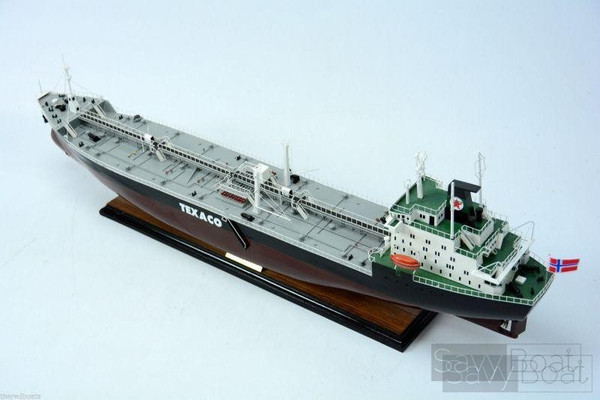
TEXACO BERGEN OIL TANKER
SAVY DIRECT PRICE $449.96MSRP: $499.99TEXACO BERGEN OIL TANKER FULLY BUILT AND READY TO DISPLAY MUSEUM QUALITY SHIP MODEL Dimension approx.: 31″ L x 5″ W x 10″ H The model is already built. THIS IS NOT A MODEL SHIP KIT When... -


TEXACO STOCKHOLM OIL TANKER
SAVY DIRECT PRICE $449.96MSRP: $499.99TEXACO STOCKHOLM OIL TANKER FULLY BUILT AND READY TO DISPLAY MUSEUM QUALITY SHIP MODEL Dimension approx.: 31″ L x 5″ W x 10″ H The model is already built. THIS IS NOT A MODEL SHIP KIT -
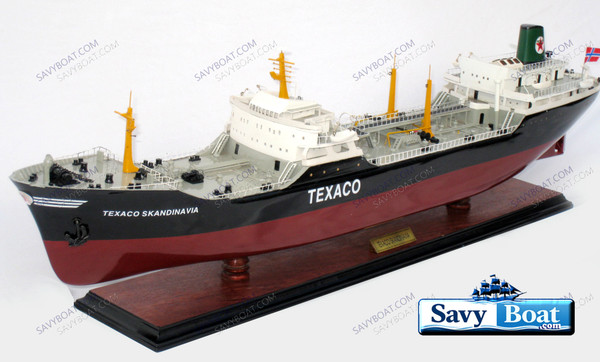
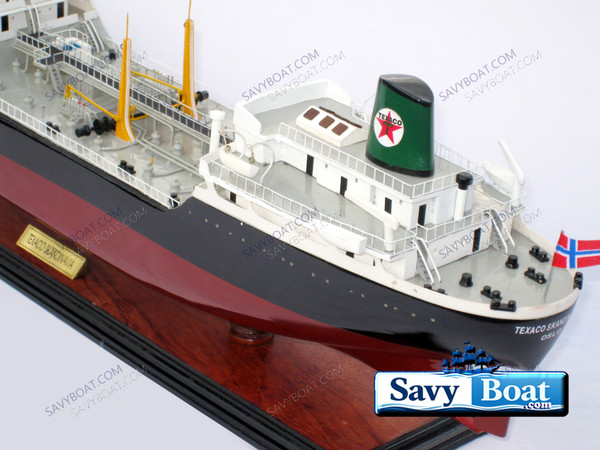
TEXACO SKANDINAVIA DIESEL TANKER
SAVY DIRECT PRICE $449.96MSRP: $499.99TEXACO SKANDINAVIA DIESEL TANKER FULLY BUILT AND READY TO DISPLAY MUSEUM QUALITY SHIP MODEL Dimension approx.: 32″ L x 5″ W x 10″ H The model is already built. THIS IS NOT A MODEL SHIP...
Description

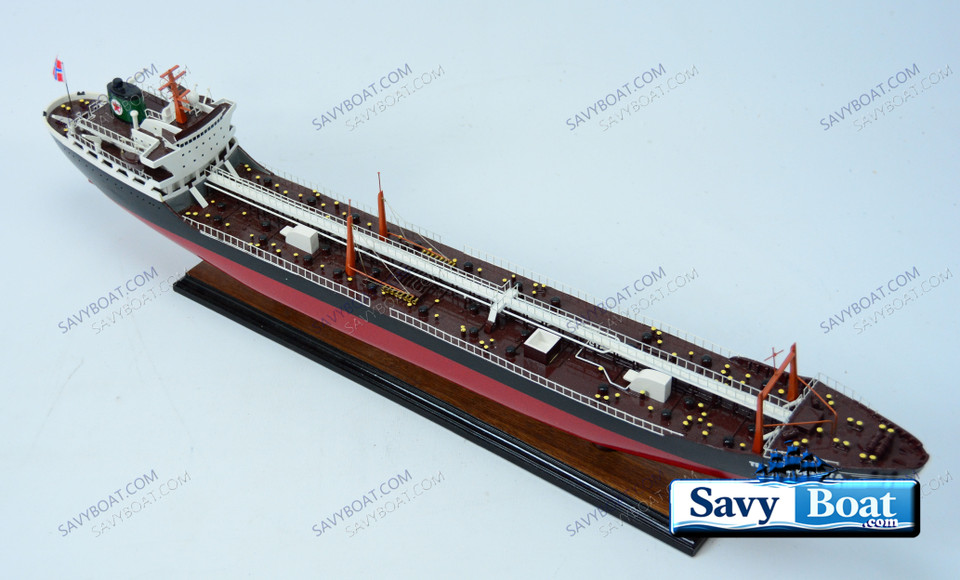
TEXACO BOGOTA OIL TANKER
FULLY BUILT AND READY TO DISPLAY MUSEUM QUALITY SHIP MODEL
- Dimension approx.: 31″ L x 4″ W x 8.3″ H
- The model is already built. THIS IS NOT A MODEL SHIP KIT
Texaco Bogota — A Tanker Rebuilt by Fire and Time
The Texaco Bogota began her life at Eriksberg Mekaniska Verkstads A/B in Gothenburg, Sweden, where she was launched on 11 August 1959. Built for The Texas Company (Norway) A/S, she represented the confident stride of Scandinavian shipbuilding at the end of the 1950s — a modern diesel tanker designed for the demanding petroleum routes of Northern Europe. When she was completed on 1 April 1960, she entered service as one of Texaco’s newest Norwegian‑flag vessels, managed by H. C. Mathiesen in Oslo. In 1961, the company became Texaco Norway A/S, and the vessel adopted the Texaco branding that would define most of her career.
With a length of 170.9 meters and a deadweight capacity of nearly 20,000 tons, the Texaco Bogota was a substantial ship for her era. Her single Burmeister & Wain diesel engine, producing 8,750 BHP, pushed her along at roughly 15 knots, a dependable speed for the long shuttle routes between Scandinavian ports and Western Europe. She carried a crew of 39 in 1968 and operated with the steady reliability expected of mid‑century tankers.
But her long career would be defined by one dramatic and nearly fatal event.
The 1968 Explosion — A Ship Torn Open
On 24 June 1968, while sailing in ballast from Norrköping, Sweden to Milford Haven, Wales, the Texaco Bogota suffered a catastrophic midship explosion east of Öland. The blast ripped open the starboard side of tanks 3 through 7, tearing frames and plating down to the waterline. Fire swept through the damaged section, and although it was extinguished the same day, one crew member was killed.
The ship was left gravely wounded — listing, structurally compromised, and barely afloat. She was towed first to Landskrona, then to Gothenburg, where naval architects undertook an extraordinary reconstruction effort. The repairs were extensive:
-
The hull was lengthened
-
The accommodation block was moved aft
-
The damaged midship section was rebuilt from the keel up
-
Her tonnage was increased
Against all odds, the Texaco Bogota returned to service on 14 December 1968, transformed and strengthened. Few tankers of her era survived such catastrophic damage, making her restoration a notable chapter in Scandinavian maritime engineering.
Through the 1970s and early 1980s, the Texaco Bogota continued operating as part of Texaco’s international fleet. In 1986, she was sold to Getty Marine Corp., managed by Texaco Maritime Services in Port Arthur, Texas, though she retained her name. By 1990, she was renamed Star Bogota, reflecting the corporate rebranding common in Texaco’s late‑century tanker operations.
Her ownership changed again in 1991, when she became Hera under Incom Shipping Ltd., and in 1992, she was sold to Laconia Shipping Co. of Piraeus, Greece, renamed Laconia, and continued trading into the late 1990s.
After nearly forty years of service — including a near‑fatal explosion, a major rebuild, and multiple ownership transitions — the vessel was sold for scrap in 1999 for USD 840,000. She arrived at Chittagong, Bangladesh on 5 October 1999, where dismantling began the following spring, ending the long life of a tanker that had endured more than most.
The Texaco Bogota stands out among Texaco’s mid‑century fleet not only for her longevity but for her dramatic 1968 explosion and subsequent rebirth. Her story illustrates both the dangers inherent in tanker operations and the resilience of well‑built ships — vessels that, even after catastrophic damage, could be rebuilt and returned to decades of service. She remains a notable example of Scandinavian shipbuilding, Texaco’s global tanker operations, and the evolving maritime industry of the 1960s–1990s.