




-

TEXACO NORGE' DIESEL TANKER
SAVY DIRECT PRICE $449.96MSRP: $499.99TEXACO NORGE' DIESEL TANKER FULLY BUILT AND READY TO DISPLAY MUSEUM QUALITY SHIP MODEL Dimension approx.: 32″ L x 5″ W x 10″ H The model is already built. THIS IS NOT A MODEL SHIP... -

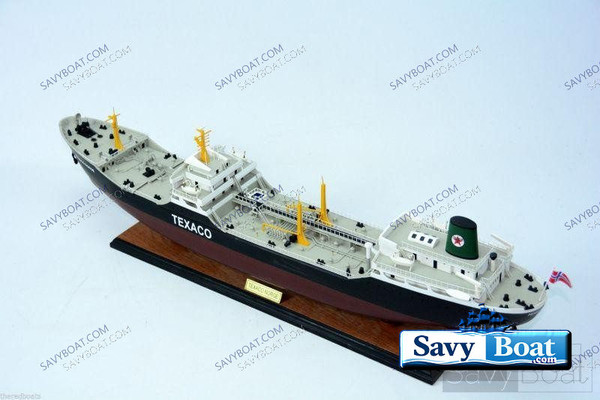
TEXACO OSLO DIESEL TANKER
SAVY DIRECT PRICE $449.96MSRP: $499.99TEXACO OSLO DIESEL TANKER FULLY BUILT AND READY TO DISPLAY MUSEUM QUALITY SHIP MODEL Dimension approx.: 32″ L x 5″ W x 10″ H The model is already built. THIS IS NOT A MODEL SHIP... -

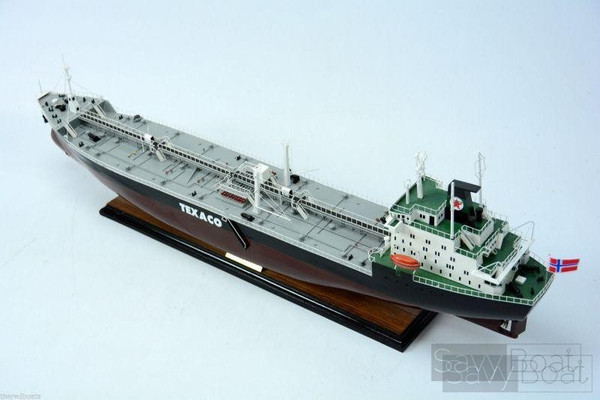
TEXACO BERGEN OIL TANKER
SAVY DIRECT PRICE $449.96MSRP: $499.99TEXACO BERGEN OIL TANKER FULLY BUILT AND READY TO DISPLAY MUSEUM QUALITY SHIP MODEL Dimension approx.: 31″ L x 5″ W x 10″ H The model is already built. THIS IS NOT A MODEL SHIP KIT When...
Description

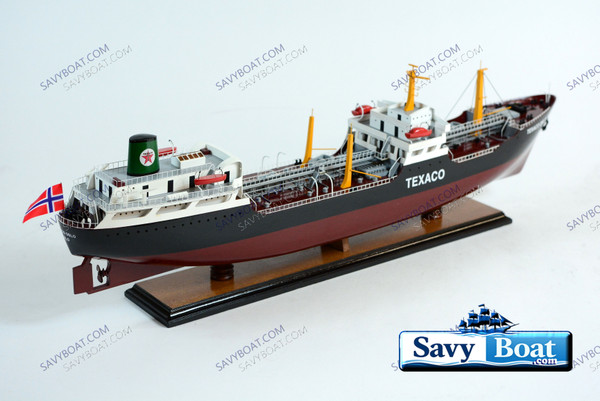
TEXACO SKANDINAVIA DIESEL TANKER
FULLY BUILT AND READY TO DISPLAY MUSEUM QUALITY SHIP MODEL
- Dimension approx.: 32″ L x 5″ W x 10″ H
- The model is already built. THIS IS NOT A MODEL SHIP KIT
Texaco Skandinavia — A Norwegian Workhorse of the Diesel Tanker Era
When the Texaco Skandinavia was launched at Fredriksstad Mekaniske Verksted on 21 July 1962, she represented the confident industrial stride of Norway’s postwar shipbuilding boom. Built for Texaco Norway A/S, she was designed as a mid‑sized, diesel‑powered tanker capable of serving the expanding petroleum trade that linked Scandinavian refineries with ports across Europe.
Completed on 7 November 1962, the Skandinavia measured 176.3 meters in length and carried over 20,000 tons of deadweight. Her single Götaverken VGS7U diesel engine, producing 8,750 BHP, pushed her to a service speed of 14.5 knots — a reliable, economical pace for long coastal and regional voyages. With ten 3,000‑m³ cargo tanks and pumping capacity of 3,000 m³/h, she was engineered for steady throughput, loading and discharging petroleum products with efficiency that matched the needs of the era.
For nearly a quarter century, from 1962 to 1986, the Texaco Skandinavia served under the Norwegian flag, managed by Per R. Sundby in Oslo. She became a familiar sight in North Sea and Baltic waters, part of Texaco’s long‑standing Norwegian fleet — a fleet whose roots stretched back to the 1930s and whose ships played vital roles during and after World War II. The Skandinavia carried that legacy forward, operating through decades of growth in European oil consumption and the rise of modern tanker logistics.
Her first major transition came in January 1986, when she was sold to Getty Marine Corp. (managed by Texaco Marine Services in Port Arthur, Texas). She retained her name, continuing her work much as before, though now under American corporate oversight. By 1990, she was sold again, this time to Texaco Panama Inc., and renamed Star Skandinavia — a change that reflected the increasingly globalized ownership structures of late‑20th‑century tanker fleets.
The final chapter of her operational life unfolded quickly. In May 1992, she was sold to Neter Navigation Panama, registered in Kingstown, St. Vincent & The Grenadines, and renamed simply Skandi. Later that same year, she was sold to a hulk buyer for USD 700,000, signaling the end of her commercial usefulness. On 12 July 1992, she arrived at Alang, India, one of the world’s largest ship‑breaking yards. By 25 July, dismantling began at Priya Holdings Pvt. Ltd., and the steel that had carried millions of barrels of petroleum across three decades began its final transformation.
The Texaco Skandinavia’s story mirrors the evolution of the global tanker trade from the 1960s through the early 1990s — from national fleets and regional service to multinational ownership, shifting registries, and eventual recycling on the beaches of South Asia. She was a dependable, diesel‑driven workhorse, built in Norway, operated across continents, and ultimately retired in India. Her long service life stands as a testament to the durability of mid‑century tanker design and the changing tides of Texaco’s maritime operations.