




-


TEXACO BOGOTA OIL TANKER
SAVY DIRECT PRICE $449.96MSRP: $499.99TEXACO BOGOTA OIL TANKER FULLY BUILT AND READY TO DISPLAY MUSEUM QUALITY SHIP MODEL Dimension approx.: 31″ L x 4″ W x 8.3″ H The model is already built. THIS IS NOT A MODEL SHIP KIT -

TEXACO BERGEN OIL TANKER
SAVY DIRECT PRICE $449.96MSRP: $499.99TEXACO BERGEN OIL TANKER FULLY BUILT AND READY TO DISPLAY MUSEUM QUALITY SHIP MODEL Dimension approx.: 31″ L x 5″ W x 10″ H The model is already built. THIS IS NOT A MODEL SHIP KIT When... -
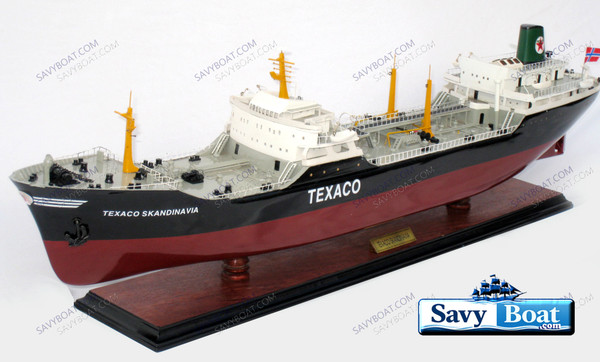
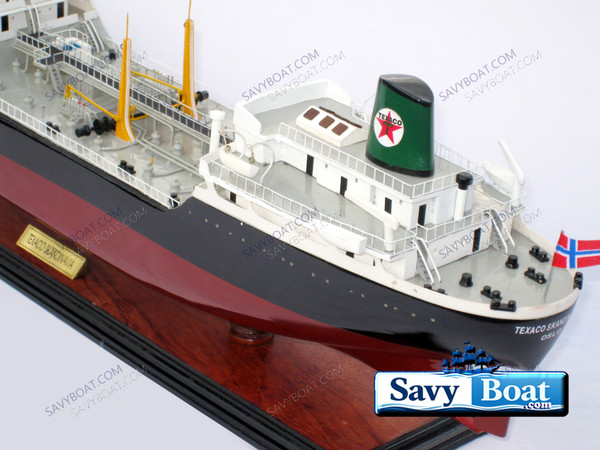
TEXACO SKANDINAVIA DIESEL TANKER
SAVY DIRECT PRICE $449.96MSRP: $499.99TEXACO SKANDINAVIA DIESEL TANKER FULLY BUILT AND READY TO DISPLAY MUSEUM QUALITY SHIP MODEL Dimension approx.: 32″ L x 5″ W x 10″ H The model is already built. THIS IS NOT A MODEL SHIP...
Description

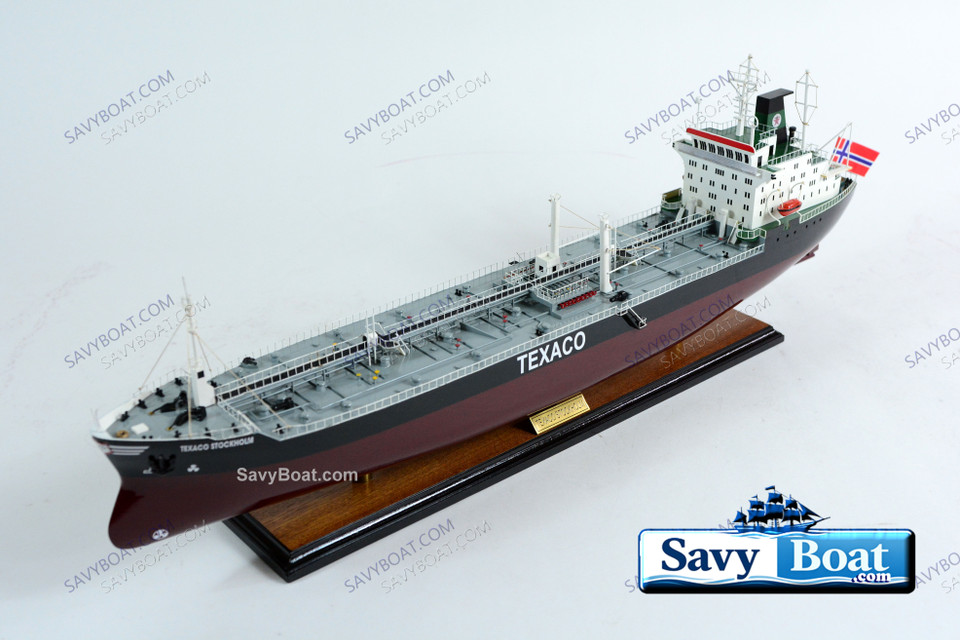
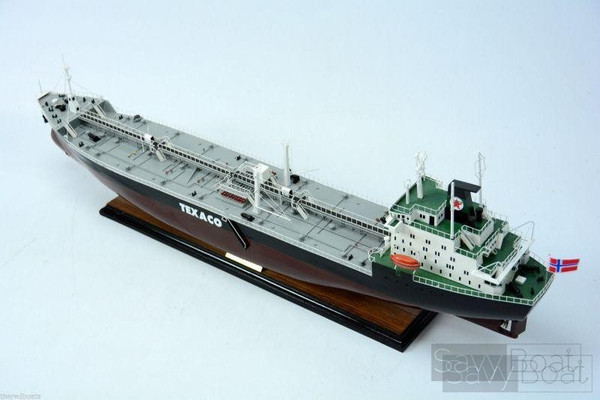
TEXACO STOCKHOLM OIL TANKER
FULLY BUILT AND READY TO DISPLAY MUSEUM QUALITY SHIP MODEL
- Dimension approx.: 31″ L x 5″ W x 10″ H
- The model is already built. THIS IS NOT A MODEL SHIP KIT
Texaco Stockholm — A North Sea Tanker Through Changing Tides
When the Texaco Stockholm entered the water at A/S Horten Verft on 24 June 1977, she joined a generation of Norwegian‑built tankers designed for the demanding petroleum trade of Northern Europe. Solidly engineered and powered by a 12,000‑BHP Sulzer diesel, she was built not for glamour but for endurance — a vessel meant to shoulder the constant movement of crude and refined products across the cold, industrial arteries of the North Sea.
Commissioned for Manufacturers Hanover Trust Co. and operated by Texaco Norway A/S, the Stockholm measured 168.8 meters in length and carried over 31,000 tons of deadweight. Her cargo system was sophisticated for the era: a network of single‑bottom, double‑bottom, and center tanks served by six hydraulically driven Deepwell and Booster pumps capable of moving 5,400 m³/h. She was a working ship through and through, built to load, carry, and discharge efficiently in ports from Scandinavia to Western Europe.
Through the 1980s, the Texaco Stockholm operated steadily under Texaco’s Norwegian management. Like many tankers of her class, she became part of a shifting corporate landscape as the oil industry globalized. In 1986, management passed to Intership A/S, followed by Barber International A/S in 1990, and then Norsk Texaco A/S in early 1991. Later that same year, she came under Texaco Marine Services Inc. in Port Arthur, Texas — a sign of Texaco’s increasingly international fleet operations.
Her identity changed dramatically in 1991, when she was renamed Star Pembroke and re‑registered in Nassau, Bahamas. Over the next decade, she would undergo multiple changes in ownership, registry, and even tonnage. In 1993, her official deadweight was reduced; in 1995, she was sold to Triumph Maritime Ltd. of Malta and renamed San Carlos; and in 1996, her tonnage was increased again to 31,500 DWT. By 1998, she was under the management of Fullship S.r.l., continuing her long commercial career in Mediterranean and international service.
The most dramatic chapter of her life came in October 2005, when the tanker — still operating as San Carlos — was attacked by Somali pirates. Like many commercial vessels transiting the Gulf of Aden during that turbulent era, she was seized and held for ransom. After three weeks, she was released following a payment of USD 650,000, a stark reminder of the risks faced by merchant ships in the early 2000s.
By 2006, nearly three decades after her launch, the ship’s working life had reached its end. She was sold for scrap at USD 376 per DWT and sailed to Chittagong, Bangladesh, arriving on 14 July 2006. There, on the beaches of one of the world’s busiest ship‑breaking yards, the Texaco Stockholm was dismantled — her steel and machinery recycled into new industrial uses.
Across her long career, the Texaco Stockholm reflected the evolution of the global tanker trade: shifting corporate ownership, fluctuating tonnage classifications, international registries, and the hazards of piracy in the modern era. She served faithfully from the late 1970s into the mid‑2000s, a durable Norwegian‑built tanker that weathered decades of change before completing her final voyage to the breakers.